It’s late afternoon at a campground. Your kids are spread around the loop: one at the bathhouse, one on a bike near the creek trail, one at a friend’s site. You want to reach them without yelling across the road. You also don’t want to hand out phones in a spot where signal is a rumor. That is the job the Best Walkie Talkies for Kids for Outdoor Play and Camping do. They give kids some independence and give you a way to reach them that works with no cell service, no data plan and no passwords.
I’m Karl D. McGrath, and I put this list together from research, not hands-on testing. The picks come from manufacturer specifications, owner feedback and how each radio is designed to be used. I haven’t run range trials or drop tests, so I won’t quote any. Where a detail such as battery type, channel count or warranty can vary by listing or bundle, I tell you to confirm it on the Amazon page before buying.
The category splits in two. Toy-grade radios suit young children. They have short range, big simple buttons and a low price, so a lost or dropped set isn’t a disaster. FRS and GMRS-style consumer radios suit older kids. They offer better range, weather resistance, more channels and privacy codes, and sometimes weather alerts, but they are heavier, cost more and have more buttons to learn. Pick by your child’s age and by how the radios will be used.
Treat every “up to X miles” claim as a best-case, line-of-sight figure from open terrain. Trees, hills, tents, vehicles and buildings cut real-world range sharply, often to a fraction of the headline number. A campground or backyard needs reliable range of a few hundred yards, not the advertised maximum. I’ve organized the seven picks by need: the youngest kids, tight budgets, waterproof and floating use, rechargeable power, longer range and multi-kid group play. Camping is the main setting, but this is a guide to kid communication and safety gear, not a packing list.
Our top picks
- Best overall for families (ages 8+ and parents): Motorola Talkabout T200
- Best waterproof and rechargeable option for wet, muddy trips: Motorola Talkabout T600
- Best value pack for groups of kids or two families: Midland X-TALKER T51VP3
- Best floating, rechargeable radios with the longest advertised range: Cobra ACXT645
- Best for long-range group camping with older kids: Midland LXT600VP3
- Best budget set for school-age kids in a backyard or small campground: Retevis RT22
- Best toy-style walkie talkies for younger kids (about ages 3 to 8): Topsung M880
Comparison chart
Specs such as channel counts, range claims, batteries and bundle contents can change between listings and revisions. Use this chart to compare the options, then confirm the details on the Amazon page. Range figures are manufacturer best-case claims, so the chart doesn’t repeat them.
| Product | Best for | Key spec (radio type, channels, claimed range) | Power source | Warranty (confirm on Amazon listing) |
|---|---|---|---|---|
| Motorola Talkabout T200 | Best overall for families (ages 8+ and parents) | FRS 2-pack; multiple channels with privacy codes; claimed range is best-case, open terrain only | AA batteries (verify on listing) | Confirm on listing |
| Motorola Talkabout T600 | Waterproof, floating and rechargeable for wet, muddy trips | FRS; H2O-series waterproof and floating design (verify exact rating); weather alert channels; privacy codes; claimed range is best-case | Rechargeable pack, alkaline backup possible (verify on listing) | Confirm on listing |
| Midland X-TALKER T51VP3 | Value pack for groups of kids or two families | FRS 3-pack; large channel selection with privacy settings; weather scan; claimed range is ideal-conditions only | AA batteries or optional rechargeable setup (verify on listing) | Confirm on listing |
| Cobra ACXT645 | Floating, rechargeable radios with the longest advertised range | FRS; waterproof and floating design; weather channel access; long claimed range, optimistic in wooded terrain | Rechargeable batteries (verify charging method on listing) | Confirm on listing |
| Midland LXT600VP3 | Long-range group camping with older kids | GMRS/FRS-capable 3-pack; wider channel count; weather scan and alert; VOX option; GMRS use requires a license for adults in the US | Check listing for included battery type | Confirm on listing |
| Retevis RT22 | Budget set for school-age kids in a backyard or small campground | Compact multi-radio pack; multiple channels; VOX option (verify on listing); built for short-distance play | Verify battery type on listing | Confirm on listing |
| Topsung M880 | Toy-style radios for younger kids (about ages 3 to 8) | Toy-style 2-pack with simple controls; short, play-focused range, much shorter than FRS radios | Verify battery type on listing | Confirm on listing |
Next come the individual picks, starting with the radio I’d choose for most families.
Best Overall for Families: Motorola Talkabout T200

Key Features
- Sold as a 2-pack of FRS consumer radios, so one goes to a parent and one to a child
- Multiple channels with privacy codes to reduce overlap with other campers
- Weather-channel scanning (confirm on the listing)
- Powered by AA batteries (confirm the count and whether any are included), which are easy to restock at camp
- Simple push-to-talk layout that school-age kids can learn quickly
The Talkabout T200 is the radio I would point most families toward first. It is a proper consumer radio rather than a toy, but it does not bury kids in menus. Press the big button, talk, release. An 8- or 9-year-old can pick that up in a few minutes, and a parent can set the channel and privacy code once and leave it.
Motorola advertises a long maximum range for this model. Treat that as an open-terrain, best-case figure. Among trees, tents, and hills, expect a small fraction of it. For a campground loop or a stretch of woods behind a cabin, that is usually enough, but check the exact claim on the listing and plan around a few hundred yards, not miles.
What we liked
- Easy controls suit school-age kids
- Privacy codes help keep neighboring campers’ chatter out
- AA power means a spare pack from any store keeps it running
What we did not like
- It is not marketed as waterproof, so keep it away from creeks and heavy rain
- Only two radios, so a third child or a second parent needs another set
- Alkaline batteries add up over a long trip
Why we picked it
It balances simplicity, recognizable brand support, and the features that matter outdoors. If your kids are 8 or older and your camping is mostly dry-weather campground play, this is the safest all-around choice.
Best for Wet, Muddy Trips: Motorola Talkabout T600

Key Features
- Marketed in Motorola’s H2O line as waterproof and floating (confirm the exact rating on the listing)
- Rechargeable battery pack, with alkaline backup supported (confirm on the listing)
- Weather alert channels
- Larger channel count with privacy codes
- Built for rain, creek play, and lake or kayak days
- Heavier and pricier than toy walkie talkies
Kids and water find each other at nearly every campsite, and that is where the T600 earns its place. A radio that tolerates rain, splashes, and a dunk in the shallows takes away a lot of worry. The floating design also means a radio dropped off a dock or out of a canoe does not simply disappear.
The rechargeable pack is convenient at home and at a site with power, but it is a planning item on a remote trip. Check that you can fall back on AA batteries if the pack runs down, and bring a charging plan. This radio is also bulkier than a toy set and costs more, so it suits older kids who will keep track of it rather than a 5-year-old who will leave it in the sandbox.
What we liked
- Water-ready build suits rainy or creek-side trips
- Floating design reduces the risk of losing it in a lake
- Rechargeable power cuts down on battery purchases
What we did not like
- Costs noticeably more than entry-level sets
- Too much radio for young children
- Recharging needs a power source, which can be a hassle off-grid
Why we picked it
If your family’s camping tends to involve rain, mud, or water, durability matters more than saving a few dollars. The T600 is the pick for kids who are old enough to handle a sturdier radio and active enough to need one.
Best Value Pack for Groups: Midland X-TALKER T51VP3

Key Features
- Sold as a 3-pack, so more kids, or a parent plus two kids, can share a channel
- Large channel selection with privacy settings
- Weather scan and alert capability (confirm on the listing)
- Manufacturer-claimed range that applies to ideal conditions only
- AA batteries or an optional rechargeable setup (confirm what is included)
- Suited to cousin trips, scout-style outings, and larger campsites
Two radios are fine for one parent and one child. Add a second child and the pairing falls apart, which is why a 3-pack makes sense for larger groups. The X-TALKER T51VP3 puts three radios on the same channel so everyone can hear each other, and it usually costs less per radio than buying two sets.
The trade-off is that a shared channel gets noisy quickly when several kids are talking. A short set of ground rules helps: keep messages brief, no chatter during check-ins, and the parent’s radio has priority. As with any FRS-style radio, the advertised range is a best-case figure, so expect much less in woods.
What we liked
- Three radios cover a small group without buying a second set
- Privacy settings help limit interference from nearby campers
- Good fit for two families sharing a campsite
What we did not like
- A group on one channel means more talking over each other
- More buttons and settings than a toy set, so younger kids may struggle
- Confirm which batteries and accessories come in the box
Why we picked it
For groups of three or more, the T51VP3 delivers the most useful radios per dollar of the first three picks. It works best with kids old enough to follow channel and check-in rules.
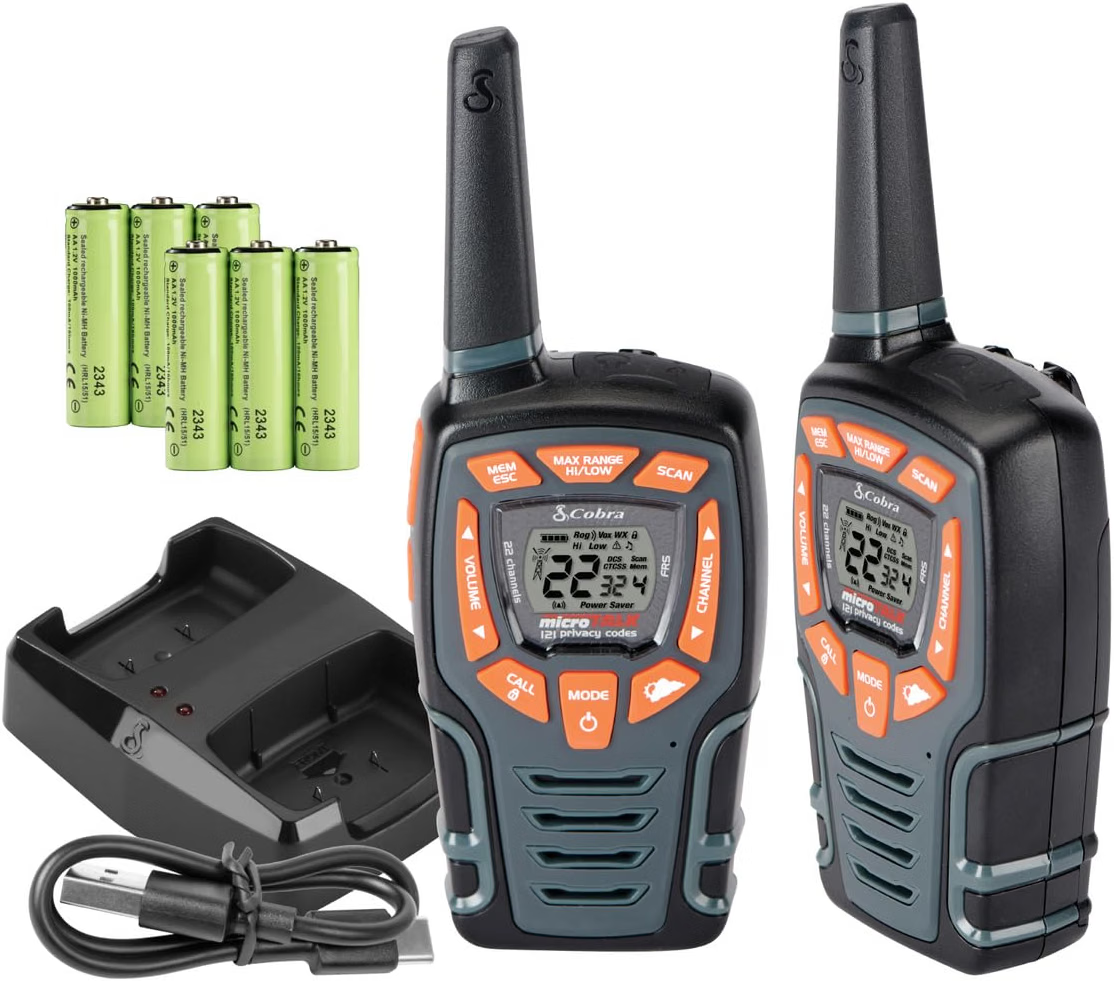
Best for Floating, Rechargeable Radios With Long Advertised Range: Cobra ACXT645
Key Features
- Waterproof, floating design (confirm the exact waterproof rating on the listing)
- Rechargeable battery option (confirm whether the listing uses a charging cradle or a cable)
- Access to weather channels
- Long manufacturer-claimed range, which is a best-case figure
- Sturdy build aimed at older kids and teens
The ACXT645 is made for wet, rough use. If your kids spend camp days at a river, lake or beach, a radio that floats and tolerates a dunking is worth having. Because these are rechargeable, you can top them up at night from a car charger or power bank instead of carrying spare AAs, though you should check the listing for what is in the box and how it charges.
Treat the big range number on the box as an open-terrain, line-of-sight claim. In a wooded campground with hills and tents in the way, expect far less. The radio makes more sense for its durability and weather features than for any promise of miles of coverage. It is also more radio than a seven-year-old needs.
What we liked
- Floating, waterproof design suits water-heavy trips
- Rechargeable power cuts down on battery shopping
- Weather channel access adds a safety layer
What we did not like
- Costs more than toy-style and basic budget radios
- Too many settings for young kids
- Advertised range is optimistic for wooded terrain
Why we picked it
We picked it for families whose older kids and teens are around water and rough conditions, where a rechargeable, floating radio is a practical choice.
Best for Long-Range Group Camping With Older Kids: Midland LXT600VP3

Key Features
- GMRS/FRS-capable radios sold as a value pack (confirm the radio count on the listing before ordering)
- More channels and a longer manufacturer-claimed range than entry-level radios
- Weather scan and alert (confirm on the listing)
- Hands-free VOX option
- Better suited to kids comfortable with a few more buttons and settings
This is the radio for a family group spread over several campsites. GMRS-capable radios can transmit at higher power than basic FRS models, which is why they are often advertised with longer ranges. The same caveat applies: trees, terrain and tents cut that range sharply.
One point matters before you buy. In the US, GMRS use requires an FCC license for the adult. It is fee-based with no exam, and it covers the licensee’s immediate family. FRS-only use does not need one. If you are not willing to deal with that, a license-free FRS radio is simpler. The VOX feature is also worth a caution: outdoors, wind and background noise can trigger it, so many parents will leave it off for kids and rely on push-to-talk.
What we liked
- Wider channel selection and more power than basic radios
- Weather alerts for trips in unsettled seasons
- A good match for larger, spread-out groups
What we did not like
- GMRS license requirement adds a step for parents
- More features than younger kids need
- VOX can false-trigger in wind and noise
Why we picked it
We picked it for families who want more reach and flexibility for older kids and are willing to handle GMRS licensing.
Best Budget Set for School-Age Kids: Retevis RT22

Key Features
- Sold in multi-radio packs at a low price per radio (confirm pack size on the listing)
- Compact, lightweight body for small hands
- Multiple channels and a VOX option (confirm on the listing)
- Low cost, so a lost radio is not a big loss
- Check the battery type and range claims on the listing before buying
The RT22 is a no-frills option for backyards, small campgrounds and neighborhood play. Its small size suits school-age kids, and the low price per radio means a dropped or forgotten one will not sting. The multi-radio packs also help when several kids need to share a channel.
Keep your expectations modest. This is a short-distance radio for play, not wide-open wilderness. Before ordering, check the listing for the battery type, how it charges if it is rechargeable, and whether the model is sold as license-free FRS for US buyers. It is a basic, utilitarian radio, not a rugged, weatherproof one, so keep it dry.
What we liked
- Low cost per radio
- Small, light and easy for kids to carry
- Packs make group play practical
What we did not like
- Not built for wet or rough conditions
- Limited range in woods and hills
- Specs vary by listing, so you need to read the details
Why we picked it
We picked it as the practical budget choice for school-age kids doing short-distance play where losing a radio is a real possibility.
Best for Younger Kids (Ages 3 to 8): Topsung M880

Key Features
- Toy-style design with chunky, simple controls that small hands can manage
- Sold as a 2-pack, so each child gets a radio (check the listing for whether lanyards or belt clips are included)
- Short, play-focused range, much shorter than a true FRS radio built for adult use
- Listings often mention a flashlight or backlit screen (confirm which features your version has)
- Easy enough for young children to use without learning channels or privacy codes
- A natural first set for backyard hide-and-seek, tent-to-tent chat, and playground play
The Topsung M880 sits at the toy end of this category, and that is the point of it. If your child is four or five, the Motorola and Midland radios earlier in this guide are more than they need. They have more buttons, more menus, and more ways to end up on the wrong channel. A radio for this age group has to do two things: let a child press a button and talk, and survive being dropped in the dirt. The M880 is aimed at that job. I have not used it myself. What follows is based on the manufacturer’s listing, how this style of radio is designed to be used, and the kind of feedback owners usually leave for toy-grade sets.
Range is the main thing to set expectations about. Toy-grade radios generally work over a short distance, and that distance shrinks quickly once trees, tents, vehicles, and uneven ground get between the two radios. Listings for kids’ radios, including this style, often advertise a range in miles. Treat that as an ideal open-field figure. In a campground, plan on the radios covering the distance between your site and the next one, or a small play area where you can still see or hear the kids. That suits a young child. A five-year-old should not be far enough away that range matters. For that age, the radio works best as a way to say “come back for dinner” or to let siblings play spy games without shouting.
Before buying, check the listing for the details that vary between versions and sellers: battery type, whether batteries are included, whether the flashlight is on both radios, and how many channels there are. Also check whether the set is a true toy-class device or a low-power consumer radio. That affects how it behaves around other campers’ radios. Cheap radios of this kind can pick up interference from other nearby devices, and some children will accidentally leave the transmit button pressed. Show your child how to press, talk, release, and listen. If you are camping at a busy site, a quick test at the start of the trip tells you more than the box does.
What we liked
- Simple operation suits children who cannot yet handle channels, codes, or menus
- A 2-pack gives each child a radio right out of the box
- The toy-style build and short range fit backyard, playground, and close-quarters campsite play
- Flashlight or backlit-screen features (where included) make tent-to-tent use after dark more fun
- Replacing it costs far less than replacing a rugged outdoor radio if it gets lost or broken
What we did not like
- Range is much shorter than the FRS radios in this guide, and it drops further in woods or hilly ground
- Not designed for rain, creeks, or lake days, and I would not count on it floating or surviving a soak
- Kids will outgrow it, since older children quickly find the range and features limiting
- Specs and included accessories can differ by seller, so you need to read the listing carefully
- It will not give you dependable contact across a large campground, so it is no substitute for supervision
Why we picked it
We picked the Topsung M880 because it is the right kind of radio for the youngest group, children roughly three to eight, who just want to press a button and talk. It gives up range and ruggedness in exchange for simplicity and low cost, and for backyard play or a few campsites’ worth of distance that is a reasonable trade. Skip it if your kids are older, if you want contact across a wide area, or if you expect wet and muddy conditions. In those cases, look at the Motorola Talkabout T600 or the Cobra ACXT645 instead.
Buyer’s guide: how to choose
Toy walkie talkies vs. FRS/GMRS radios: which one fits your child’s age
Toy-style radios, like the Topsung M880, suit roughly ages 3 to 8. They have simple buttons, short range, and no channel or code decisions. FRS/GMRS-style radios, like the Motorola Talkabout and Midland models here, suit kids who can follow rules and handle a few more settings, usually around 8 and up. They reach farther and tolerate weather better, but they are also easier to misuse.
Understanding range claims: why “up to 30 miles” becomes a few hundred yards in the woods
Advertised range assumes open, line-of-sight conditions, such as two radios on opposite hilltops. Trees, hills, tents, vehicles, and even your own body cut that sharply. At a wooded campground, plan on a fraction of the printed figure. Pick the radio for your actual campsite layout, not the biggest number on the box.
Waterproof, splash-resistant, and drop-resistant: what the ratings really mean for camping
“Water-resistant” generally covers rain and splashes. “Waterproof” or “floating” designs are meant to survive brief immersion. Check the exact rating on the listing rather than trusting a headline. Drop resistance is rarely rated, so a budget radio that costs little to replace can be the smarter choice for a young child.
Batteries: AA vs. rechargeable, and what to pack for a weekend trip
AA radios are easy to restock at any camp store. Rechargeables are cheaper over time, but they need a charging source, which can be a problem without power. For a weekend, pack a spare set of AAs or a charged power bank and the right cable. Confirm the power options on each listing, since some models support both.
Channels, privacy codes, and avoiding other campers’ chatter
FRS radios share a limited pool of channels with everyone nearby. Privacy codes filter out other users’ transmissions on your radio, but they do not encrypt anything, so anyone on that channel can still hear you. Before you head out, choose a channel and code, write them down, and have each child check that theirs match.
Ease of use for kids: button count, PTT size, volume limits, and clip or lanyard options
Look for a large push-to-talk button, a clear volume control, and as few buttons as possible. Kids lose radios, so a belt clip or lanyard helps. Hands-free VOX sounds convenient, but wind and noise can trigger it, so many parents leave it off for younger kids.
GMRS licensing and FRS rules: what US parents need to know
In the US, FRS radios do not require a license. GMRS radios do, and the license is held by an adult and covers the licensee’s immediate family. Some radios, like the Midland LXT600VP3, can operate on GMRS channels, so read the product details and the current FCC rules before using those higher-power channels. Rules change, so check the FCC’s own site.
Safety rules to set before handing over a radio: check-in times, boundaries, and emergency use
- Set a check-in schedule, such as every 30 minutes, and agree on what happens if a child misses one.
- Define boundaries by landmarks, like the bathhouse or the lakeside sign.
- Keep the channel clear for urgent calls, and make sure kids know a radio is a convenience, not a guarantee of rescue.
- Teach them to stay put and call if they are lost.
How many radios you need for a group, and whether a parent should keep a spare
You need one radio per child who roams, plus one for each adult who wants to listen. A 2-pack covers one child and one parent. For two or three kids, a 3-pack or two sets is more practical. A spare radio or spare batteries stays useful if one gets dropped, soaked, or left behind.
Accessories worth considering: lanyards, headsets, and spare battery packs
Lanyards keep radios from getting lost in the grass. Compatible headsets can help in noisy spots, but they may add complexity for younger kids, so check compatibility first. A spare battery pack or a bundle of AAs is the cheapest insurance against a dead radio on day two.
Frequently Asked Questions
What age is appropriate for a first walkie talkie?
Many kids can use a simple toy-style set from around age 3 to 5 for backyard play. For FRS-style radios, around 8 is a reasonable starting point, but it depends on your child’s maturity and how well they follow rules.
How far will kids’ walkie talkies really work at a campground?
Much less than the box claims. Expect a fraction of the advertised range in wooded or hilly campgrounds. Open fields and lakes get closer to the claim, but never assume the maximum, and test the radios at your site before kids wander off.
Do I need a license to use walkie talkies with my kids?
For FRS-only radios in the US, no license is required. For GMRS operation, an adult needs an FCC license, which covers their immediate family. Check the radio’s listing and the FCC’s current guidance.
Are waterproof walkie talkies necessary for camping?
Not always. If the kids will be near water, in heavy rain, or in mud, waterproof or floating radios are worth the extra cost. For dry weather and short walks, a splash-resistant or standard radio is often enough.
Are rechargeable or AA-powered walkie talkies better for camping trips?
It depends on access to power. AA radios are the safer choice for remote camping because spares are easy to carry and buy. Rechargeables are fine if you have a way to charge them, especially for longer trips or frequent use.
Can strangers hear my kids on the radio?
Yes. FRS and GMRS channels are shared, and privacy codes do not encrypt anything. Anyone nearby on the same channel can hear, so teach kids not to share names, locations, or personal details.
What is the difference between FRS and GMRS?
FRS is a license-free radio service with limits on power and equipment. GMRS allows more power and some additional equipment options, but it requires a license in the US. Many consumer radios cover FRS channels, and some also include GMRS capability.
How many channels do kids really need?
Not many. One or two reliable channels are enough for most family use. More channels help if you are in a crowded campground and need to move away from interference, but they also add complexity for younger kids.
Can walkie talkies replace phones for kids at camp?
They can replace phones for local contact, especially where there is no signal, but they are not a substitute for emergency communication. Keep a charged phone or another emergency option with an adult.
How do I teach kids to use a walkie talkie properly?
Practice before the trip. Show them how to press and hold the button, wait a beat, speak clearly, and release to listen. Set simple rules: no yelling, no unnecessary chatter, and keep the channel clear for check-ins and urgent calls.
Final thoughts
If you want one radio set that works for most families, I would start with the Motorola Talkabout T200. It is a straightforward FRS set that school-age kids can learn quickly, and the AA power is easy to restock. For groups, cousins, or two families sharing a site, the Midland X-TALKER T51VP3 is the best value pick because the 3-pack puts more people on the same channel.
Whichever you choose, set the channel, agree on check-in times, and test the range at your campsite before the kids head out. That habit does more for safety than any spec on the box.