The TPMS light comes on at a rural exit, hours from the nearest town. The gas station has an air machine, but it’s out of order, wants quarters you don’t have, or has a hose that won’t reach the rear tire. Most road trippers have been there at least once.
A portable tire inflator is cheap insurance against it. It lives in the trunk and turns a trip-ruining delay into a ten-minute stop. It also makes a good pre-trip habit, because you can top off all four tires in your driveway instead of hoping a station machine works.
I’m Karl D. McGrath, and this guide covers inflation only. It’s a different job from the jump starter and dash cam guides here, and it doesn’t cover flat repair or plugging punctures. An inflator and a jump starter do make a good pair in a trunk kit, but I’ll keep that to a short mention later.
One rule matters more than which inflator you buy: check pressures when the tires are cold, and set them to the number on the door-jamb placard, not the maximum printed on the tire sidewall. The sidewall number is the tire’s limit, not your car’s recommendation.
I chose these seven by need. They include a heavy-duty 12V pick for SUVs and trucks, an accurate digital 12V for everyday cars, a cordless option for convenience, two tool-battery or hybrid models for people who already own the batteries, and two budget picks.
This guide is written from research: manufacturer specifications, listing details and owner feedback. I haven’t run hands-on tests, so I don’t quote fill times or performance numbers. Where a spec varies by version or I can’t confirm it, the chart points you to the manufacturer’s listing.
The trade-offs are the same for all of them. Small inflators have duty cycles, they get hot, they’re loud, and they fill large tires slowly. Cordless models are limited by their batteries. None of them are meant to run nonstop.
Our top picks
- Best for SUVs, light trucks and larger tires: VIAIR 88P Portable Compressor
- Best for accurate, set-and-forget inflation on everyday cars: JACO SmartPro Digital Tire Inflator
- Best for cordless power or 12V plug-in with a high pressure ceiling: DEWALT DCC020IB 20V MAX Tire Inflator
- Best for people already invested in the M12 battery platform: Milwaukee M12 Compact Inflator 2475-20
- Best for compact, rechargeable cordless inflation with no battery platform: Fanttik X8 APEX Tire Inflator
- Best for a budget-friendly 12V backup in a trunk kit: AstroAI Tire Inflator Portable Air Compressor
- Best for simple, budget-friendly emergency top-offs: EPAuto 12V DC Portable Air Compressor Pump
Comparison chart
| Product | Best for | Power source | Max PSI | Warranty |
|---|---|---|---|---|
| VIAIR 88P Portable Compressor | SUVs, light trucks and larger tires | 12V DC | 120 PSI | Check the manufacturer’s listing for current terms |
| JACO SmartPro Digital Tire Inflator | Accurate, set-and-forget inflation for everyday cars | 12V plug-in | Check the manufacturer’s listing | Check the manufacturer’s listing for current terms |
| DEWALT DCC020IB 20V MAX Tire Inflator | Cordless power or 12V plug-in, with a high pressure ceiling | 20V MAX battery (sold separately) or 12V | 160 PSI | Check the manufacturer’s listing for current terms |
| Milwaukee M12 Compact Inflator 2475-20 | Owners of the M12 battery platform | M12 battery (sold separately) | 150 PSI | Check the manufacturer’s listing for current terms |
| Fanttik X8 APEX Tire Inflator | Compact cordless inflation with no battery platform needed | Built-in rechargeable battery | Check the manufacturer’s listing | Check the manufacturer’s listing for current terms |
| AstroAI Tire Inflator Portable Air Compressor | Budget 12V backup for a trunk kit | 12V plug-in | Check the manufacturer’s listing | Check the manufacturer’s listing for current terms |
| EPAuto 12V DC Portable Air Compressor Pump | Simple, budget-friendly emergency top-offs | 12V DC plug-in | Check the manufacturer’s listing | Check the manufacturer’s listing for current terms |
A higher maximum PSI doesn’t make an inflator better for a typical car. Most passenger cars call for roughly 30 to 45 PSI, so a 120 PSI limit and a 160 PSI limit are both far more than you need.
Duty cycle, build quality, gauge accuracy, hose reach and power source matter more, and the buyer’s guide below covers each of them. Some models also come in several versions with different specs or bundled accessories, so confirm the details on the listing you’re about to buy.
Best for SUVs and larger tires: VIAIR 88P Portable Compressor

Key Features
- 12V portable compressor with a maximum rating of 120 PSI
- Built for heavier-duty use than most budget inflators
- Supplied with a hose, air chuck and carry bag
- Aimed at larger passenger tires and light-truck sizes
- Check the manufacturer’s listing for current warranty terms
The VIAIR 88P is the pick for anyone whose tires are bigger than a compact sedan’s. VIAIR is a well-known name in 12V compressors, and this model is a step up from the plastic plug-in inflators that fill the rest of this guide.
That matters on a loaded SUV or a light truck, where a small inflator can take a long time to add a few PSI to each tire and runs hot while it does.
One thing to check before buying is how it connects to power. Compressors in this class draw more current than many vehicle accessory outlets are meant to supply, so they often connect directly to the battery terminals instead.
Read the listing for the connection method and the current draw, and make sure you can reach all four tires with the hose and cord. It is also a bulkier, heavier unit than a glovebox inflator, and it is not a quiet one.
What we liked
- A heavier-duty build suited to bigger tires than budget inflators handle
- 120 PSI maximum, which is plenty for any passenger or light-truck tire
- A carry bag keeps the hose and fittings together in the trunk
What we did not like
- It takes up more trunk space than compact or cordless units
- Higher power draw means you should confirm how it connects and run the engine while using it
- It still has a duty cycle, so large tires may need rest breaks
- It is more than most small-car owners need
Why we picked it
If you drive an SUV or light truck, tow, or run bigger tires, I would start here. It is built for the job in a way budget inflators are not, and that margin is worth the extra bulk. Small-car drivers can save money and space with one of the picks below.
Best for everyday cars: JACO SmartPro Digital Tire Inflator

Key Features
- 12V plug-in digital tire inflator
- Preset target pressure with automatic shutoff
- Digital gauge display and built-in work light
- Designed for passenger car, SUV and light-truck tires
- Check the manufacturer’s listing for current warranty terms
The JACO SmartPro is the kind of inflator I would hand to a friend who does not want to think about it. You set the target PSI from the door-jamb placard, start the unit, and it stops when it reaches the number.
That takes most of the guesswork and the risk of overfilling out of a roadside top-off, and the built-in work light helps when the valve stem is in the dark.
Like every 12V plug-in inflator, it is a top-off tool and not a workshop compressor. Expect it to be slower on large tires, and give it breaks if it gets hot.
Run the engine while you inflate so the car’s battery is not doing all the work. It is also worth checking the unit against a separate gauge when you first get it, because any digital readout can be a few PSI off.
What we liked
- Preset pressure with automatic shutoff suits people who do not want to watch a gauge
- The digital display is easy to read
- The work light is useful for nighttime stops
- Works with passenger car, SUV and light-truck tires
What we did not like
- It is a small plug-in unit, so it will be slow on bigger tires
- It depends on your car’s 12V outlet, so reach and cord length matter
- Not meant for continuous running, so it needs breaks after longer fills
Why we picked it
For a typical sedan, crossover or hatchback, a simple digital inflator with auto shutoff covers nearly every real situation: the TPMS light, a slow leak, or a pre-trip check. The JACO SmartPro fits that role without the bulk or cost of a heavy-duty compressor.
Best for cordless or 12V flexibility: DEWALT DCC020IB 20V MAX Tire Inflator

Key Features
- Runs on a 20V MAX battery (sold separately as a bare tool) or on 12V power
- Maximum rating of 160 PSI
- Digital display with an automatic shutoff setting
- Built-in LED light
- Rugged tool-brand build; check the manufacturer’s listing for warranty
The DEWALT DCC020IB is the most flexible inflator in this group. If you already own 20V MAX batteries, you can inflate away from the car with no cord to route.
If you do not, or the battery is flat, it also runs from a 12V outlet. A 160 PSI ceiling is far more than any car tire needs, but it also makes the unit useful for other gear, such as trailer tires and tools that take higher pressure.
The catch is in the name: “IB” tools are sold bare, so the battery and charger are not included. If you do not own the DEWALT 20V MAX platform, factor in that cost, or pick a self-contained model instead.
A tool battery also limits how much air you get from one charge, so a few car tires are realistic, but filling a large, completely flat tire is a different matter. Keep the 12V cord in the trunk as a backup.
What we liked
- Works from a 20V MAX battery or a 12V outlet
- Tool-brand build designed to survive a trunk or garage
- Digital display, auto shutoff and LED light cover the basics
- Great pressure ceiling for trailer tires and other uses
What we did not like
- Sold as a bare tool, so the battery and charger cost extra if you are new to DEWALT
- Battery capacity limits how many tires you can fill per charge
- Larger and heavier than a compact rechargeable inflator
Why we picked it
If you already have DEWALT 20V MAX batteries, this is the easiest recommendation in the guide: one tool, two power options, and a build that fits a working truck or garage. If you are starting from scratch, a plug-in or built-in-battery model will likely cost less.
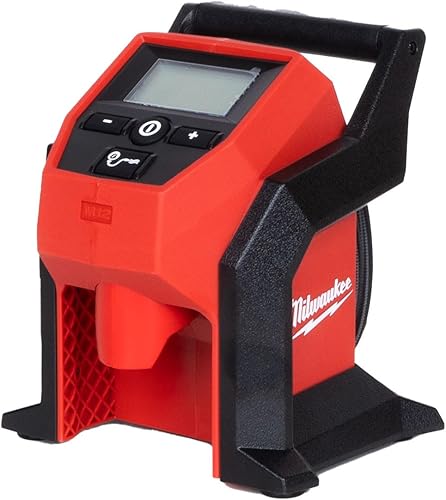
Best for M12 battery owners: Milwaukee M12 Compact Inflator 2475-20
Key Features
- Compact inflator powered by M12 batteries (bare tool, battery sold separately)
- Maximum rating of 150 PSI
- Digital gauge with automatic shutoff
- Small enough to store in a trunk or tool bag
- Check the manufacturer’s listing for current warranty terms
If you already own Milwaukee M12 tools, this is the easiest way to add an inflator to your trunk. You skip paying for a second battery and charger, and you probably already have a charged pack on the shelf.
I’m writing this from manufacturer information and owner feedback, not from hands-on testing. The idea is simple: grab a battery from the garage, drop it in the inflator, and you have cordless air for the car, a trailer, or a bike.
The “bare tool” part matters. If you don’t own M12 batteries, you have to buy a battery and charger as well, and that usually makes it a poor value next to a self-contained inflator. Cordless inflators also have limits.
Run time depends on the battery’s capacity and charge, and topping off several larger tires will drain a small pack faster than a quick top-off on a sedan. Pack a spare battery if you want this to be your only road trip inflator, and keep it charged before you leave.
What we liked
- Uses batteries many M12 owners already have
- Digital gauge with automatic shutoff for set-and-walk-away inflation
- Compact enough for a trunk organizer or tool bag
- High pressure ceiling gives headroom for heavier tires and trailers
What we did not like
- Battery and charger are not included, which adds cost if you’re new to M12
- Cordless run time is limited by the battery you pair with it
- No built-in 12V plug-in option, so a dead battery means no air
Why we picked it
It’s the best fit for people already invested in Milwaukee’s M12 line who want a tidy, no-cord inflator for the trunk. If you don’t own the batteries, look at the self-contained cordless pick below instead.
Best for a self-contained cordless inflator: Fanttik X8 APEX Tire Inflator

Key Features
- Cordless design with a built-in rechargeable battery
- Digital display with preset pressure and automatic shutoff
- Compact body for glovebox or trunk storage
- Intended for car tires, bikes and sports balls via included nozzles
- Check the manufacturer’s listing for current specifications and warranty
The Fanttik X8 APEX is for drivers who want cordless convenience without buying into a tool battery platform. The battery is built in, so you charge it over USB and keep it in the car. Because there’s no cord to route, it’s handy when a tire is low in a tight parking spot or a spot where the 12V outlet cable won’t reach.
Check the current listing for exact pressure rating, battery capacity and included accessories, since Fanttik updates its models, and I don’t want to quote figures I can’t verify.
As with any compact cordless inflator, expect a trade-off between portability and endurance. A small internal battery is fine for topping off a few tires that have drifted a few PSI low, but it isn’t the tool I’d rely on to refill several large SUV or truck tires from a much lower pressure.
A battery sitting in a hot or freezing car also loses charge over time, so recharge it before a long trip rather than assuming it’s ready. Pair it with a 12V inflator if you drive a heavier vehicle.
What we liked
- No cord, no separate battery platform to buy into
- Preset pressure with automatic shutoff keeps inflation simple
- Small enough to live in a glovebox or door pocket
- Nozzles for bikes and sports balls add everyday usefulness
What we did not like
- Built-in battery limits how much air you get per charge
- Not the best choice for repeatedly filling large truck or SUV tires
- Needs periodic recharging, even if you rarely use it
Why we picked it
It’s the pick for car owners who value compactness and ease over maximum capacity. It suits compact cars, crossovers and household use, and it’s a good second inflator for people who already carry a corded one.
Best for a budget trunk backup: AstroAI Tire Inflator Portable Air Compressor

Key Features
- 12V plug-in portable air compressor
- Digital pressure display with preset auto shutoff
- Includes nozzle adapters for bikes and balls
- Low-cost option for occasional top-offs
- Check the manufacturer’s listing for current warranty terms
The AstroAI is the kind of inflator most drivers should keep in the trunk: inexpensive, plugs into the 12V outlet, and doesn’t depend on a battery that might be flat when you need it.
You set the target pressure, start it, and it stops when it reaches that number. That’s useful when you’re trying to hit the door-jamb placard figure and don’t want to babysit a gauge on the side of the road. AstroAI sells several models, so confirm the exact listing and its specs before buying.
Be realistic about what a budget 12V inflator is. It’s designed for occasional use, and small compressors build heat, so follow the maker’s duty-cycle guidance and let it rest between tires.
It will also be louder and slower than a heavy-duty unit, especially on larger tires. For a sedan or compact crossover that needs the odd top-off, that’s an acceptable compromise. If you drive a loaded SUV or truck, or fill tires from very low pressures often, the VIAIR is the better tool.
What we liked
- Low-cost way to add roadside air to a trunk kit
- Plugs into the 12V outlet, so no battery to keep charged
- Preset auto shutoff makes hitting a target pressure straightforward
- Adapters make it useful for bikes and sports balls too
What we did not like
- Built for occasional use, not continuous running
- Likely slower and noisier than heavy-duty compressors
- Not the best match for large truck tires or frequent fills
Why we picked it
It’s the budget choice for drivers who want a dependable backup without spending much. It does the basics, and that’s enough for most everyday cars.
Best for simple emergency top-offs: EPAuto 12V DC Portable Air Compressor Pump

Key Features
- 12V DC plug-in design that runs from a car’s power outlet
- Digital gauge with a preset shutoff function, so you set a target pressure and the pump stops when it gets there
- Includes a carry bag and common nozzle adapters
- Designed for passenger car tires and occasional use
- Check the manufacturer’s listing for current warranty terms
The EPAuto is the most stripped-down pick in this guide, and I mean that as a description rather than a criticism. It does not run on a tool battery or have a built-in rechargeable pack, and it is not built for heavy-duty work.
It plugs into the 12V socket, you set a target pressure, and it inflates to that number. For many drivers that is the whole job: a tire a few PSI low on a cold morning, a TPMS light at a rural exit, or a spouse’s car that has not had its pressures checked in months.
The preset shutoff is the feature that matters most here. You read the door-jamb placard, dial in that number, start the pump and let it stop on its own. That removes the usual cheap-inflator habit of watching the gauge and guessing. Still, treat the built-in gauge as a convenience reading.
A decent standalone gauge costs little, and checking the final pressure with it is a good habit with any inflator in this price tier. I have not tested this unit myself, so these notes come from the manufacturer’s listing and general owner feedback for this type of pump, not from my own measurements.
The honest trade-offs are the usual ones for compact 12V compressors. They are loud, and the plug-in cord limits your reach, so check the listing for cord and hose length before assuming it will stretch to the far tire on a longer vehicle.
Duty cycle is the bigger issue. Small pumps like this are meant to run in short bursts, and the heat builds if you push them. If you are topping off four tires at a few PSI each, plan on pauses between them.
If you are inflating large SUV or light-truck tires from low pressure, the VIAIR 88P at the top of this guide is the better tool. This EPAuto is for the occasional, ordinary-car use it is designed for.
It also overlaps with the AstroAI pick, which is aimed at a similar buyer. If you are choosing between the two, compare the current listings for cord length, included adapters and the details of how each handles the preset shutoff, and let those, along with price, decide it. Both belong in the “keep it in the trunk and hope you rarely need it” category.
What we liked
- Simple plug-in operation with no batteries to charge or forget about
- Preset shutoff takes most of the guesswork out of reaching a target pressure
- Carry bag and nozzle adapters keep it organized in a trunk kit and let it handle bikes and balls
- A sensible fit for occasional top-offs on passenger cars
- Pairs well with a jump starter and a standalone gauge in a basic road trip emergency kit
What we did not like
- Not built for continuous running, so heat and duty cycle limit it on bigger jobs
- Likely to be slow and noisy on larger SUV and truck tires, as with most compact 12V pumps
- Cord and hose reach is a practical limit, so confirm the lengths on the current listing
- The built-in gauge should be confirmed with a separate gauge if accuracy matters to you
- Depends on a working 12V outlet and fuse, and some vehicles only power the outlet with the ignition on
Why we picked it
I picked the EPAuto for the driver who wants cheap insurance and nothing more. It is a plug-in pump with a preset shutoff, a bag and the basic adapters, and it suits someone who checks pressures before a trip and wants a backup for the occasional low tire.
If you drive a heavy truck, fill large tires regularly or want cordless freedom, spend more on one of the other picks. If your needs are small and your budget is tight, this is a reasonable thing to leave under the cargo floor.
Buyer’s guide: how to choose
Corded 12V vs cordless: how to choose
A 12V plug-in inflator draws power from your car, so it never runs out of charge, and it is the safer choice for a trunk kit that sits for months. Cordless models are easier to use and store, but they depend on a battery you must keep charged. I
f the inflator lives in the car all year, a 12V unit is the lower-maintenance option. If you want something you can carry to the tire without a cord, go cordless and top up the battery before every trip.
Max PSI, and why most cars only need 30-45 PSI
Most passenger cars call for roughly 30 to 45 PSI. A 120 or 160 PSI rating is not something you will use on a normal tire. Any inflator on this list covers the pressure you need, so a high ceiling mainly signals a sturdier motor and pump. Light-truck tires with higher recommended pressures are the exception, so check your own placard.
Duty cycle and heat: why you shouldn’t run an inflator nonstop
Small compressors build heat quickly, and most are meant for short bursts followed by a rest. Check the manufacturer’s listing for the stated run time and cool-down guidance, and treat it as a limit. Filling four large tires from low pressure is where a budget unit is most likely to overheat or shut itself off. Stop and let it cool instead of forcing it.
Digital gauge accuracy and auto shutoff
A preset-and-shutoff feature is the best convenience upgrade, because you set the target, start the pump and walk away. Built-in gauges can be off by a few PSI, though, and I can’t vouch for any specific unit’s accuracy without testing. Confirm the final number with a separate gauge you trust, especially if you are close to the placard value.
Hose length and reach to all four tires
Combine the hose length, the power cord length and the way your car is parked. A short hose on a 12V unit can force you to reposition the car, particularly on larger SUVs and trucks where the outlet is far from the rear wheels. Check the listing for cord and hose lengths, and for a screw-on chuck, which holds the valve better than a lever clamp.
Noise, size and where it lives in your trunk
Every portable compressor is loud, and heavier-duty ones are louder and bulkier. That matters less in an emergency but more if you top off tires in a garage or hotel parking lot. A compact unit that fits in the glovebox or a seat pocket gets used more than a big one buried under luggage, so choose a size you will realistically keep within reach.
Power draw: 12V outlet fuse limits and engine-on use
Car accessory outlets are fused, commonly in the 10 to 15 amp range, though it varies by vehicle. Check your owner’s manual and the inflator’s rated current draw. Run the engine while inflating so you don’t drain the battery, and unplug the unit before starting the car. A unit that blows the outlet fuse is a common cause of an “it just stopped” complaint.
Extras that matter: LED light, nozzle adapters, carry bag
An LED light helps when you find a low tire at night. Nozzle adapters let one tool inflate bikes and balls, and a carry bag keeps the hose and accessories from rattling around. These are nice but secondary. Rank pump quality, power source and shutoff accuracy first.
How to find your correct tire pressure (door-jamb placard, not sidewall)
The correct pressure is on the placard on the driver’s door jamb, and often also in the owner’s manual. The number molded into the tire sidewall is the tire’s maximum pressure, not the recommendation for your car. Check pressures when the tires are cold, meaning the car has sat for a few hours or been driven only a short distance.
Building a road trip emergency kit with an inflator, gauge and jump starter
An inflator, a reliable pencil or digital gauge and a jump starter cover the two most common roadside problems: low tires and a dead battery. If you are putting together the battery side, see my guide to the best portable car jump starters for cold weather and dead batteries. Add gloves, a flashlight and your owner’s manual, and keep everything in one bag.
Frequently Asked Questions
What PSI should my car tires be at?
Use the number on the driver’s door-jamb placard or in your owner’s manual. It is specific to your vehicle, and it is not the maximum printed on the sidewall.
Can I use a portable tire inflator without the engine running?
A 12V inflator can work with the engine off in many cars, but it draws a lot of current and can drain the battery. Running the engine is the safer habit. Cordless models run on their own battery.
How long does it take to inflate a tire with a portable inflator?
It depends on the inflator, the tire size and how much air is needed. Topping off a few PSI is quick. Filling a large tire from low pressure takes noticeably longer, so I won’t quote times I haven’t measured. Check each listing for the stated inflation rate.
Can a portable inflator fill a completely flat tire?
Sometimes, if the tire is only low and undamaged. If it has a puncture or a damaged sidewall, it will not hold air for long, and you should not drive on it. Inflation does not repair a flat.
Are cordless tire inflators powerful enough for SUVs and trucks?
Many reach the required pressure, but battery capacity limits how much they can do in one charge. They suit top-offs better than refilling several large tires. For frequent or heavy use, a 12V unit or a tool-battery model with a larger pack is the safer choice.
Do I still need a separate tire pressure gauge?
I recommend it. A separate gauge lets you double-check the built-in display, and it still works if the inflator fails.
How often should I check tire pressure on a road trip?
Check before you leave and then at fuel stops when the tires are still reasonably cool. Heavy loads and big temperature swings are good reasons to check more often.
Why did my inflator get hot and shut off?
Most likely it hit its duty-cycle limit, or protection circuits tripped because of heat or high current draw. Let it cool, then continue in shorter sessions. Check the listing for the manufacturer’s guidance.
Will a portable inflator work on bike tires and sports balls?
Often yes, if it comes with the right adapters. Schrader valves are the same type as car valves, while Presta valves usually need an adapter. Check that the listing includes the needle or nozzle you need.
Is a portable inflator a substitute for a spare tire or repair kit?
No. An inflator only adds air. You still need a spare or a repair or sealant option for a puncture, plus a plan for roadside assistance.
Final thoughts
After going through specs, manufacturer information and owner feedback, my top pick for most road trippers who drive SUVs, trucks or carry heavy loads is the VIAIR 88P Portable Compressor, because it is built for heavier use than most budget inflators. For the best value, the AstroAI Tire Inflator Portable Air Compressor is a sensible low-cost backup for a trunk kit, as long as you treat it as a tool for occasional top-offs and not continuous work. Whichever you choose, check your pressures cold against the door-jamb placard before you leave, and verify current specs and warranty terms on the listing before you buy.