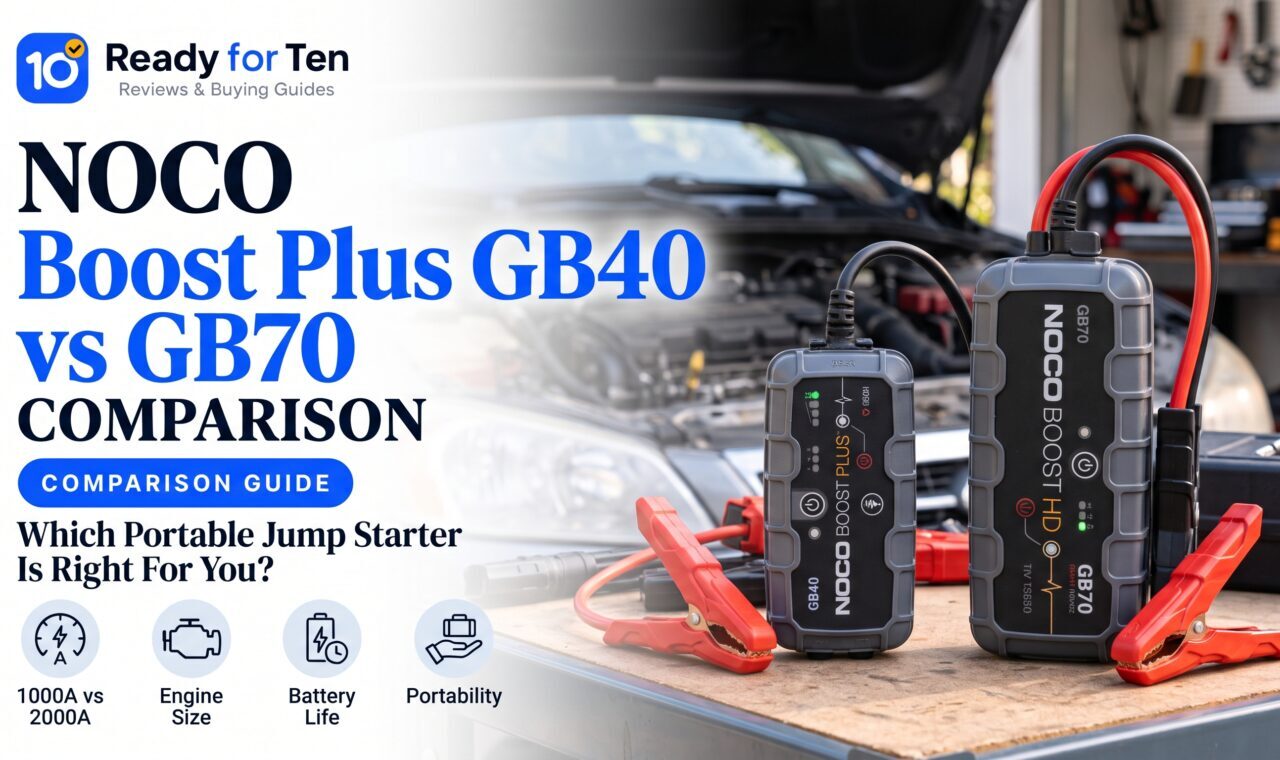
If you are comparing the NOCO Boost Plus GB40 vs NOCO Boost Pro GB70, you are really deciding how much engine you need to start and how much room you want to give yourself. Both are 12-volt lithium jump starters with NOCO’s spark-proof, reverse-polarity-protected design, so the difference is mostly power, size and extras, not basic safety.
The short answer: the NOCO Boost Plus GB40 is the better buy for most people. If you drive a sedan, hatchback, crossover or small-to-midsize SUV with a gas engine, it has enough power, takes up little room and costs less. The NOCO Boost Pro GB70 is the one to get if you have a V8 truck, a diesel pickup, a work van or a boat or RV, or if you want headroom for cold mornings and a battery that has been dead for days.
A note on sourcing: I wrote this comparison from NOCO’s published specifications, the product listings and what owners report. I did not bench-test either unit for this article. NOCO’s figures can change between production runs and listings, so confirm the peak amps, engine limits and port list on the current Amazon page before you buy. Where I say “about,” that is the reason.


At a glance
| Criterion | NOCO Boost Plus GB40 | NOCO Boost Pro GB70 |
|---|---|---|
| Rated peak current | About 1000 amps | About 2000 amps |
| Engine limits (NOCO’s stated) | Roughly up to 6.0L gas and 3.0L diesel | Roughly up to 8.0L gas and 6.0L diesel |
| Typical vehicle fit | Cars, crossovers, small SUVs, most mid-size gas engines, motorcycles and lawn tractors | Full-size trucks, big V8s, diesel pickups, work vans, RVs, boats |
| Size and storage | The more compact of the two; easier to fit in a glovebox or seat pocket | Larger and heavier; better suited to a trunk, truck console or under-seat space |
| Safety features | Spark-proof, reverse-polarity protection, clamp indicators | Spark-proof, reverse-polarity protection, clamp indicators |
| Dead-battery help | Manual override for deeply discharged batteries | Manual override for deeply discharged batteries, with more power in reserve |
| Jumps per charge (NOCO’s claim) | Fewer; NOCO quotes a figure in the range of 20 | More; NOCO quotes a figure in the range of 40 |
| Extras | LED flashlight and USB output for phones | Brighter LED flashlight, USB output and a 12V accessory output; confirm against the listing |
| Price position | Lower; the value pick | Higher; you pay for capacity and headroom |
| Best for | Everyday emergency use in ordinary gas vehicles | Big engines, diesels and buyers who want a safety margin |
Two caveats on the table. First, peak amps are a marketing-style rating, not a guarantee of cranking performance. What matters is how the unit behaves on your engine, in your climate, with your battery’s condition, which is why I lean on NOCO’s engine-size limits more than on the amp number. Second, I have kept prices out because they move often. Check the current price on each listing; the gap between the two is the real cost of the extra power.
The sections below go through each criterion in turn, from starting power and vehicle fit to size, safety, cold weather, charging, extras, build quality and value, and name a winner for each.
Engine size and starting power: NOCO Boost Plus GB40 vs NOCO Boost Pro GB70
This is the main difference. The GB40 is rated at about 1,000 peak amps. NOCO states it for gas engines up to roughly 6.0 liters and diesels up to about 3.0 liters. The GB70 is rated at about 2,000 peak amps, with stated limits of roughly 8.0 liters gas and 6.0 liters diesel. Peak amps are a manufacturer rating, not a guarantee for every vehicle or temperature, so confirm the exact figures on the current Amazon listing and NOCO’s site before you buy.
On paper, the GB70 covers nearly everything on the road. The GB40 covers most passenger vehicles but stops short of big diesels.
Winner: NOCO Boost Pro GB70.
Real-world vehicle fit
If you drive a sedan, hatchback, crossover or small-to-mid SUV with a four- or six-cylinder gas engine, the GB40 is sized for that job. A V6 minivan or a typical V8 within the 6.0L limit is also on its list, though a V8 is where the margin starts to shrink.
The GB70 is the safer choice for heavy-duty pickups, diesel trucks, work vans, larger RVs and boats with big engines. These vehicles have large-displacement engines and often bigger or multiple batteries, and they are where an undersized jump starter fails. If your vehicle is near the GB40’s stated limit, buy the GB70.
Winner: GB70 for versatility. The GB40 is enough for typical commuter cars.
Size, weight and glovebox storage
The GB40 is the more compact of the two and is the one to put in a glovebox, console or door pocket in most cars. The GB70 is noticeably larger and heavier. I would plan on a seat-back pocket, under-seat space, a truck’s door bin or the trunk. I’m not quoting exact dimensions or weights here because they vary by listing. Compare them against your glovebox before ordering.
Winner: NOCO Boost Plus GB40.
Safety and ease of use
Both use NOCO’s spark-proof, reverse-polarity-protected design. If you clamp onto the wrong terminals, the unit shouldn’t send power through. Both also have LED status indicators that show when the clamps are connected correctly and the unit is ready.
The process is the same for a first-timer. Connect red to positive and black to a clean metal ground or the negative terminal. Wait for the ready indicator, start the vehicle, then disconnect. Both also have a manual override button for batteries too depleted for the unit to detect. Use it with care, because it bypasses the safety checks, so check the clamps by eye first. Neither is harder to use than the other.
Winner: Tie.
Cold-weather and dead-battery performance
I haven’t tested either unit hands-on. This section is based on the specs, NOCO’s published information and owner feedback. Cold thickens engine oil and weakens the battery, so a starter needs more current from the jump pack. The GB70’s larger power reserve gives it more headroom, particularly on diesels and big gas engines. The GB40 should be fine for a small car in a mild winter, but it is nearer its limit on a large engine in deep cold.
Both have the override for very flat batteries. A truly dead battery needs more energy, which again favors the bigger unit. For a wider cold-weather comparison, see our roundup of the best portable car jump starters for cold weather and dead batteries.
Winner: NOCO Boost Pro GB70.
Battery capacity, standby life and recharging
NOCO rates the GB40 at up to about 20 jump starts per full charge, with the GB70 listed higher. Check the current listing for the GB70 figure, because that is a best-case number on a smaller engine. A big engine or a deeply drained battery will use far more of the charge. Both are lithium units that hold a charge in storage for a long time, but they self-discharge slowly, so top them up every few months. Do this at least before winter and before road trips. Both recharge by cable. Confirm the charging port type and the included cable on each listing.
Winner: GB70 on capacity. Recharging is comparable.
Extra features and ports
Both have a built-in LED flashlight with several modes, including strobe and SOS, which is helpful for roadside emergencies at night. Both also have a USB output for charging a phone. The GB70’s light is rated brighter on the listing, and the two models differ in other ports and accessory outputs. Confirm what each includes on the current Amazon page rather than relying on a general rule. Treat the USB port as a convenience for emergencies, not a power-bank replacement.
Winner: NOCO Boost Pro GB70, modestly.
Build quality, cables and clamps
Both have NOCO’s rugged plastic casing and insulated clamps. The GB70 is built for larger loads, so expect heavier clamps and cabling, and I’d check the cable length against your engine bay layout. Longer reach helps on trucks and boats, where the battery may be far from where you can set the unit.
Heat and cold both matter to lithium packs kept in a vehicle. NOCO lists operating and storage temperature ranges, so check them before leaving either unit in a sun-baked car or a freezing garage. If you can, keep it inside the cabin or out of direct sun.
Winner: GB70 for heavier-duty hardware, though both feel purpose-built.
Price and value
The GB70 costs more than the GB40, and I’m not quoting dollar figures because prices change. Check the current price on both listings. Also check the listing title, since NOCO’s GB70 has been sold under different product-line names. For a typical driver with a four- or six-cylinder car, the extra power often goes unused, so the GB40 is better value. If you have a big gas engine, a diesel or a vehicle you rely on, the GB70 is worth the premium because it removes the doubt.
Winner: GB40 for typical drivers; GB70 for heavy-duty vehicles.
Which should you buy?
NOCO Boost Plus GB40: Buy this if you drive a sedan, crossover, small SUV or similar gas vehicle and want a compact emergency unit that fits in the glovebox. It also suits a household with several smaller cars. Skip it if you have a diesel pickup, a large V8, a work van or a heavy RV, or if your engine is near the stated limit.
NOCO Boost Pro GB70: Buy this if you own a large gas engine, a diesel, a truck, van, RV or boat, or if you simply want headroom for cold mornings and flat batteries. Accept the larger size and higher price. Skip it if you have a small car, little storage space and no plans to start anything bigger.
Frequently Asked Questions
Can the NOCO Boost Plus GB40 jump-start a V8 truck?
It depends on the displacement and the condition of the truck. NOCO rates the GB40 for gas engines up to roughly 6.0 liters, so a healthy 5.0L to 5.7L V8 with a modestly low battery is within its range. The trouble is the margin. A truck with a fully flat battery, a cold engine and a big V8 asks a lot of a 1000A-class unit. If you drive a V8 truck, I’d treat the GB40 as the minimum and the NOCO Boost Pro GB70 as the safer choice. Confirm the exact engine limits on the current listing before you buy.
Can the NOCO Boost Pro GB70 start a diesel pickup?
Possibly, but check your engine size against NOCO’s stated diesel limit first. The GB70 is NOCO’s stronger unit of the two, with a diesel rating that comfortably covers smaller diesels. Many modern full-size pickup diesels are 6.4L to 6.7L, though, and that can sit above the stated limit. Diesels also have high compression and often run two batteries, which makes cold starts harder on any portable jump starter. If you own a heavy-duty diesel, read NOCO’s specs carefully and consider whether a larger unit in the brand’s lineup fits better. For small diesels the GB70 is a reasonable fit.
Is the GB70 overkill for a small car or sedan?
On raw power, yes. A four-cylinder sedan or small crossover is well inside what the NOCO Boost Plus GB40 can handle. Extra headroom isn’t wasted, though. A bigger unit works less hard on each start, and it covers you if you later buy a larger vehicle or lend it to a friend with a truck. If you only ever drive small gas cars and want something that fits easily in a glovebox, the GB40 is the sensible buy. The GB70 is only overkill if you’d never use the capacity.
Will either NOCO jump starter work on a completely dead battery?
Both have a manual override for batteries too low for the unit to detect normally. That is NOCO’s answer for deeply discharged batteries, and owners report it works in many cases. It isn’t magic. A battery that is damaged, internally shorted, sulfated or frozen may not accept a jump at all. Never try to jump a battery that is frozen or visibly swollen or leaking. Use the override carefully and follow the manual, because it bypasses some of the safety checks the unit normally performs.
How often should I recharge a NOCO jump starter I keep in my car?
Check it every few months and top it up before winter and before any long trip. Lithium jump starters hold a charge well in storage but still self-discharge slowly, and a unit that has sat for a year may be too low to help you. NOCO’s manual gives its own storage and recharge guidance, so follow that over my rule of thumb. After using the unit for a jump, recharge it soon afterward so it’s ready the next time.
Can I use either one to charge my phone?
Yes, both have a USB output for charging phones and other small devices, but confirm the port types on the current listing, since the two models differ in the details. Remember that the battery’s real job is starting your car. I wouldn’t drain it to charge devices on a camping trip and then count on it for a jump the next morning. For an emergency in a parked car with a dead phone, it’s a handy backup.
Is it safe to leave a lithium jump starter in a hot or freezing car?
Extreme temperatures are the main long-term enemy of any lithium battery. NOCO publishes operating and storage temperature ranges for each unit, and a car parked in a Georgia summer or a northern January can leave those ranges. Heat shortens battery life and cold reduces output. My practical advice is to keep the unit in the cabin rather than the trunk where possible, out of direct sun, and ideally take it indoors during heat waves and deep freezes. If it’s too cold to start your car, bring the jump starter inside for a bit before you use it. For more on winter use across the category, see our roundup of portable jump starters for cold weather and dead batteries.
Can these jump starters be used on 24V systems or on motorcycles, boats and lawn tractors?
Neither is for 24V systems. Both are 12V units, so heavy trucks and equipment with 24V electrical systems are out. They are generally suitable for 12V starting batteries in motorcycles, boats, lawn tractors and similar powersports gear, with the larger GB70 being more than that kind of equipment needs. Check the manual for the battery types supported, especially if your motorcycle or watercraft uses a lithium starting battery, and don’t use either one for anything other than a 12V starting battery.
How many jump starts can I get on one charge?
NOCO publishes a “jumps per charge” figure for each model, and it is a best-case number. Treat it as an upper limit, because it assumes healthy batteries and moderate conditions. A fully flat battery in the cold uses far more of the unit’s capacity than a mildly weak one on a mild day. In everyday use, a full charge should cover several attempts, which is plenty for an emergency kit. Look up the stated figures on the current listing, and if you’ve drained the unit, recharge it before the next outing.
What should I check before buying, such as engine displacement and battery type?
- Engine displacement and fuel: compare your engine’s size in liters against NOCO’s stated gas and diesel limits for each model, and leave some margin.
- Number of batteries: a diesel with two batteries, or a vehicle that has sat for weeks in the cold, is harder to start than a daily-driven sedan.
- System voltage: confirm it’s a 12V system.
- Battery type: check that your starting battery chemistry is supported, especially on motorcycles and powersports.
- Exact model name and number: NOCO has used different marketing names across its range, so match the GB70 or GB40 model number on the listing to what you intend to buy.
- Where you’ll store it: make sure it fits the glovebox, seat pocket or trunk space you have in mind.
Final thoughts
This comparison comes down to what you drive. The GB40 is the better fit for most people with small-to-mid gas cars, crossovers and small SUVs. It’s compact, easy to store and covers the typical dead-battery emergency. The GB70 is the one to buy if you have a big gas engine, a smaller diesel, or you want a margin for cold mornings and flat batteries. Just check your engine’s displacement against NOCO’s published limits first, since the largest truck diesels can exceed them.
My advice is to buy for the largest, hardest-to-start vehicle you’re likely to need to jump, not the average one. Then store it sensibly, recharge it every few months, and keep it out of the worst heat and cold. Prices change often, so check the current listings before you decide.