The TPMS light comes on during the morning commute, or an hour into a road trip, and the nearest gas station air machine is broken, wants quarters, or is miles off your route. A trunk-sized compressor fixes that in a driveway or parking lot. I’m Karl D. McGrath, and I put this guide together for people looking for the best portable tire inflator for car use: commuters who top up a slow leak every few weeks, and road-trippers who want a backup in the cargo area.
This guide is a head-to-head between two types. Cordless rechargeable inflators run on a tool battery platform or a built-in battery, so there’s no cord to route. 12V plug-in inflators run from the car’s accessory socket or, on some models, battery clamps. I compared the seven picks on auto-shutoff presets, fill speed, noise, cord and hose reach, and trunk footprint. If you want a broader overview of the category, our earlier tire inflator roundup covers it, and I’ve tried not to repeat it here.
A note on method: I did not run my own bench tests for this guide. Everything below comes from manufacturer specs, listing details and owner feedback, and I flag anything you should verify on the current Amazon listing, since kit contents and specs can change between versions. One habit matters more than any product choice: set your target PSI from the placard on the driver’s door jamb, not the maximum number molded into the tire sidewall.
Our top picks
- Best cordless for owners of DEWALT 20V MAX batteries: DEWALT 20V MAX Tire Inflator DCC020IB
- Best cordless for owners of M18 batteries who want a compact tool: Milwaukee M18 Compact Inflator 2848-20
- Best self-contained cordless for commuters with no battery platform: Fanttik X8 APEX
- Best 12V plug-in for durability and road-trip peace of mind: Viair 88P Portable Compressor
- Best budget 12V plug-in with a digital auto-shutoff: AstroAI Portable Air Compressor Tire Inflator
- Best simple 12V plug-in for a seldom-used emergency kit: EPAuto 12V DC Portable Air Compressor Pump
- Best low-cost, no-frills 12V option for glove-box storage: Slime 40022 Tire Inflator
Comparison chart
| Product | Best for | Power type | Auto-shutoff preset | Warranty |
|---|---|---|---|---|
| DEWALT 20V MAX Tire Inflator DCC020IB | DEWALT 20V MAX battery owners (bare tool) | Cordless, 20V MAX battery (sold separately); 12V adapter cord reported, verify on listing | Yes, digital preset | Limited manufacturer warranty; confirm term on listing |
| Milwaukee M18 Compact Inflator 2848-20 | M18 battery owners wanting a compact tool | Cordless, M18 REDLITHIUM battery (sold separately) | Yes, digital preset | Limited manufacturer warranty; confirm term on listing |
| Fanttik X8 APEX | Commuters with no battery platform | Cordless, built-in rechargeable battery | Yes, digital preset | Confirm term on listing |
| Viair 88P Portable Compressor | Durability and road-trip backup | 12V plug-in | No, manual shutoff (watch the gauge) | Confirm term on listing |
| AstroAI Portable Air Compressor Tire Inflator | Budget buyers who want auto-shutoff | 12V plug-in (accessory socket) | Yes, digital preset | Confirm term on listing |
| EPAuto 12V DC Portable Air Compressor Pump | Occasional use in an emergency kit | 12V plug-in (accessory socket) | Yes, on the digital version | Confirm term on listing |
| Slime 40022 Tire Inflator | Low-cost glove-box storage | 12V plug-in | Digital display; verify preset shutoff on listing | Confirm term on listing |
Best for DEWALT 20V MAX owners: DEWALT 20V MAX Tire Inflator DCC020IB

Key Features
- Cordless, runs on DEWALT 20V MAX batteries (battery and charger sold separately in the bare-tool version)
- Digital pressure setting with automatic shutoff at the preset PSI
- Built-in LED work light for night roadside use
- Can also run from a 12V accessory-socket adapter cord (verify on the listing)
- Higher maximum pressure range suited to car, truck and bike tires (confirm the exact figure on the listing)
If you already have a DEWALT 20V MAX battery on a shelf in the garage, this is the easiest way to get a preset-and-walk-away inflator in your trunk. The bare-tool version costs less than a kit but is useless without a battery, so budget for one if you are starting from scratch. Our take comes from manufacturer specs and owner feedback, not hands-on testing.
The 12V adapter option matters for road trips. A 20V battery can go flat after a few seasons in a hot or cold trunk, and a plug-in backup cord covers that. Check the listing to confirm the cord is included with your version.
What we liked
- Auto-shutoff lets you set the PSI and handle the other tires
- Works with a battery platform many owners already have
- LED light helps with a dark valve stem
What we did not like
- Bare tool means no battery or charger in the box
- Larger than the pocket-size, self-contained inflators
- Poor value if you do not own DEWALT batteries
Why we picked it
It suits DEWALT owners who want a dependable, preset-style inflator with a battery or 12V option. Skip it if you would have to buy a battery just for tire top-ups.
Best for M18 owners wanting a compact tool: Milwaukee M18 Compact Inflator 2848-20

Key Features
- Runs on M18 REDLITHIUM batteries (bare tool; battery sold separately)
- Digital gauge with preset auto-shutoff
- Compact body that fits in a trunk organizer or tool bag
- Includes a hose and an attachment for balls and inflatables (verify the included accessories)
- Good for sharing a battery platform with cordless tools already owned
The M18 inflator is the Milwaukee counterpart to the DEWALT. Its selling point is size: the compact body slips into a trunk organizer or the tool bag you already carry. Like the DEWALT, it is a bare tool, so the real price includes an M18 battery if you do not have one.
Because it relies on a tool battery, it makes the most sense for people who keep a charged M18 pack around. Charge it before a long drive rather than assuming it will be ready. Based on specs and owner reports, not our own bench time.
What we liked
- Preset auto-shutoff takes the guesswork out of hitting target PSI
- Compact enough to stay in the car
- Shares batteries with other M18 tools
What we did not like
- No battery included
- No built-in power option for when the battery is dead (check the listing)
- Not a sensible purchase outside the M18 system
Why we picked it
It is our pick for Milwaukee households that want a small, preset inflator without adding another charger. If you are not on M18, look at the next pick.
Best self-contained cordless for commuters: Fanttik X8 APEX

Key Features
- Built-in rechargeable battery, so no tool batteries are needed
- Digital display with a preset auto-stop at the target pressure
- Compact design meant to store in a glove box or trunk pocket
- USB-C charging (confirm on the listing)
- Includes nozzle attachments for bikes and sports balls (verify the kit contents)
For commuters who do not own cordless tools, the X8 APEX is the simplest cordless route: charge it, keep it in the car, and set your PSI when the TPMS light comes on. There is no cord to untangle and no socket to hunt for.
The trade-off with any built-in-battery inflator is that it must be charged and may self-discharge if forgotten for months. Top it up every few months, and consider a 12V model if the car is your only emergency kit. Fill speed and battery runtime vary with tire size and starting pressure, so check the manufacturer’s specs and recent owner reviews for realistic expectations.
What we liked
- No battery platform required
- Small enough for a glove box or door pocket
- Preset auto-stop and digital readout
What we did not like
- Needs periodic recharging to be ready when you need it
- Battery capacity limits how many tires you can fill per charge
- Smaller compressors can be slower on big SUV or truck tires
Why we picked it
It is the easiest pick for a commuter who just wants a small, cordless, preset inflator. Road-trippers who want unlimited runtime should prefer a 12V plug-in.
Best for durability and road-trip peace of mind: Viair 88P Portable Compressor

Key Features
- 12V compressor from an established maker of automotive air compressors
- Long power cord and air hose for reaching all four tires
- Built-in analog pressure gauge
- Designed for passenger car and light-truck tires, with larger sizes needing longer fill times
- Manual shutoff, so you watch the gauge and stop it yourself (no auto-shutoff preset)
Viair is known for automotive compressors, and the 88P is the pick here for people who care more about build quality than convenience features. Based on manufacturer information and owner feedback, it suits a road-trip kit where you want something that will still work after years in a trunk.
The trade-off is attention. There is no preset to dial in, so you stand there, read the analog gauge and release the trigger or switch off at your target PSI. Check the listing for the exact power connection and the maximum pressure rating before you buy.
What we liked
- Reputation for durability among owners
- Cord and hose length that should reach every tire on a typical car
- No battery to charge or let go flat in storage
What we did not like
- No auto-shutoff, so it is easy to overshoot if you walk away
- Analog gauges are harder to read precisely, so check with a separate gauge
- Bulkier than the compact cordless models
Why we picked it
It is the sturdy, no-battery choice for drivers who put long miles on their cars and are fine watching a gauge for a minute or two.
Best budget 12V with auto-shutoff: AstroAI Portable Air Compressor Tire Inflator

Key Features
- 12V DC plug-in that runs from the cigarette-lighter socket
- Digital gauge with a preset PSI auto-shutoff
- Built-in LED light
- Multiple units of pressure (PSI, BAR, kPa, kg/cm²)
- Includes nozzle adapters for bikes and balls (verify the exact kit contents)
This is the budget pick for commuters who want the preset-and-walk-away convenience without paying for a cordless tool. You set the target PSI from your door-jamb placard, start the pump and it stops when it gets there. The LED light helps with an after-dark top-up.
Like most inexpensive 12V units, it relies on your car’s accessory socket, so check your socket’s fuse rating against the inflator’s current draw on the listing. Run the engine while you use it so the battery is not drained. Owners generally report that compact pumps of this type get warm and loud, so let it rest between tires.
What we liked
- Digital preset and auto-shutoff at a budget-friendly tier
- Pressure units for any gauge reading you prefer
- Useful for bikes and balls if the adapters are included
What we did not like
- Limited by the reach of the cord to the socket
- Small compressors are slower to fill big SUV or truck tires
- Gauge accuracy should still be double-checked with a separate gauge
Why we picked it
It offers the most useful feature, auto-shutoff, at the lowest cost of entry, and that makes it a sensible default for everyday commuters.
Best simple emergency-kit pick: EPAuto 12V DC Portable Air Compressor Pump

Key Features
- 12V DC plug-in operation from a vehicle socket
- Digital gauge with preset auto-shutoff on the digital version
- LED flashlight on the body
- Comes with a storage bag and adapters (verify the contents on the listing)
- Straightforward controls for people who only inflate occasionally
The EPAuto is for the driver who inflates a tire a few times a year and wants to stash a compressor in the trunk and forget it. The controls are simple, and the storage bag keeps the cord, hose and adapters together. Make sure you are looking at the digital version if you want the auto-shutoff preset, since the listing may include other variants.
It overlaps heavily with the AstroAI, so the choice comes down to current price, kit contents and owner reviews. Neither is the pick for frequent use on large tires.
What we liked
- Easy to use for someone who rarely inflates tires
- Storage bag helps keep everything together
- Built-in light for roadside use
What we did not like
- Cord length limits placement around larger vehicles
- Plug-in 12V pumps can be loud and heat up with repeated use
- Variants differ, so confirm you are buying the digital model
Why we picked it
It keeps things simple and gives you a digital preset for a seldom-used emergency kit, which is all many drivers need.
Best for glove-box storage: Slime 40022 Tire Inflator

Key Features
- 12V plug-in design that runs from the car’s accessory socket
- Made by Slime, a familiar name in tire-care products such as sealants and repair kits
- Digital display for reading pressure
- Compact body that is easy to stash in a trunk pocket or under a seat
- Includes common inflation nozzles (verify the exact accessories on the listing)
- Practical for occasional top-ups, less so for frequent use on large tires
The Slime 40022 is the pick for someone who wants an inflator in the car “just in case” and does not want to spend much or give up much space. It plugs into the 12V socket, so there is no battery to keep charged and nothing to forget about between uses. That is the real advantage of a 12V unit over the cordless models above. It works whenever the car does, even if you have not touched the inflator in a year.
I have not tested this unit myself, so this section is based on the manufacturer’s information and general owner feedback for compact 12V inflators in this class. Treat the following as a profile of what to expect, not a measured result. Small plug-in compressors like this are built for topping up a tire that is a few PSI low, such as the TPMS light that comes on during a cold snap. They are not built to bring a tire up from empty or to fill large truck tires. Expect a car tire to take noticeably longer than it would on a bigger compressor like the Viair 88P, and plan to let the unit rest if you are filling more than one tire. Check the listing for any duty-cycle guidance.
Before you buy, check the listing for a preset auto-shutoff. Slime’s digital display makes it easy to read the pressure, but I would not assume it stops on its own at the number you set. If it does not, you will need to watch the display and stop it yourself. Also check the power cord and hose lengths against your car, because a short cord can make it awkward to reach the far-side tires. Run it with the engine on so you do not drain the battery, and keep a separate gauge in the glove box to confirm the reading. Take the target PSI from the driver-door-jamb placard, not the tire sidewall.
What we liked
- It needs no charging, so it is ready whenever the car is running.
- The small body suits a glove box, a door pocket or a trunk organizer.
- The digital display is easier to read than a small analog dial, especially in low light.
- It is a low-cost way to add an emergency inflator to a commuter car.
What we did not like
- Compact 12V units fill slowly compared with larger compressors, so expect a longer wait on each tire.
- It is not suited to frequent use or to large SUV and truck tires.
- Auto-shutoff and warranty details need checking on the listing before you buy.
- Cord and hose reach may be tight on larger vehicles.
Why we picked it
We picked it as the low-cost, no-frills option for people who will use an inflator a few times a year. If you drive a compact car or sedan, keep your tires on a regular check schedule and mainly want a backup for the odd low-pressure warning, the Slime 40022 does that job without much cost or clutter. If you inflate tires often, drive a big SUV or want a hands-off preset, look at the AstroAI or one of the cordless picks instead.
Buyer’s guide: how to choose
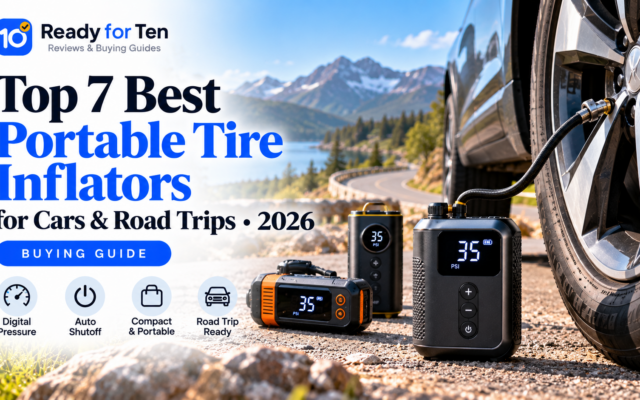
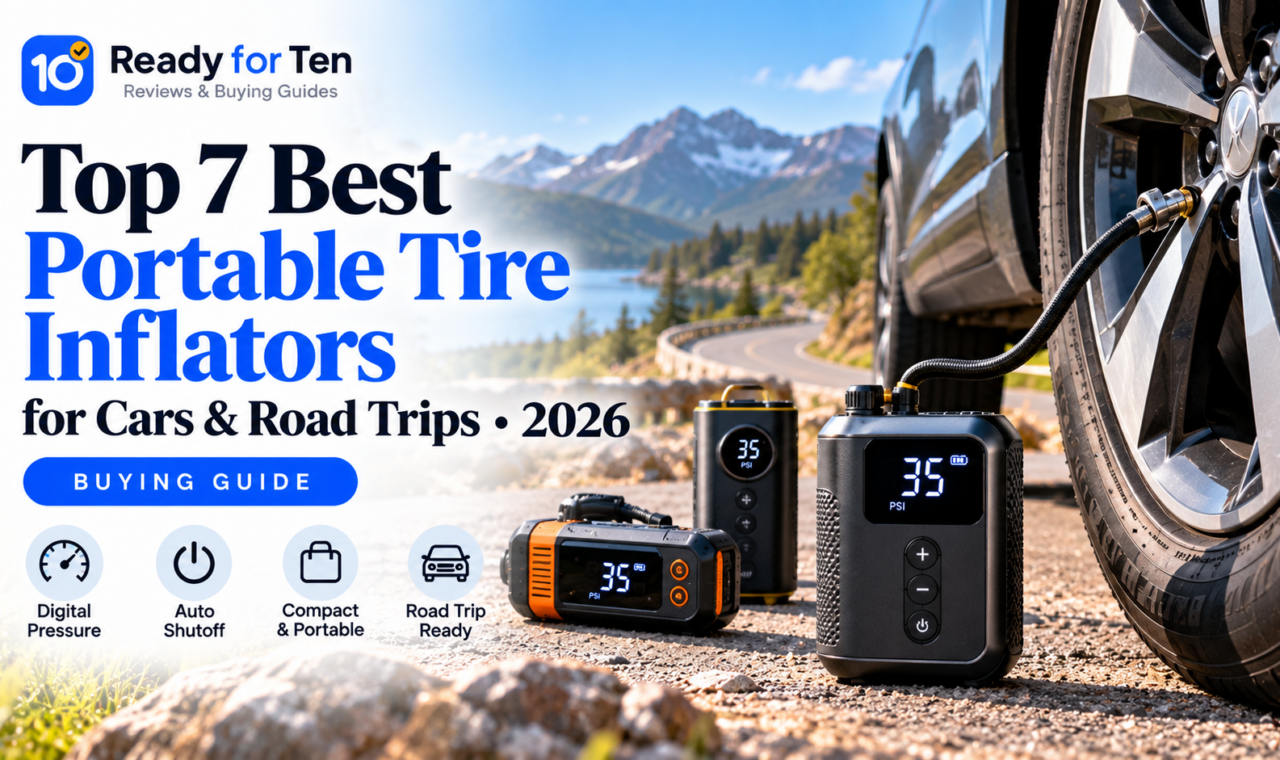
The best portable tire inflator for car use is the one you will actually pull out of the trunk. These are the factors I weigh when comparing models. They come from manufacturer specs and owner feedback, not from my own bench testing. For a second angle on the category, see our earlier roundup, Top 7 Best Portable Tire Inflators for Cars and Road Trips of 2026.
Cordless rechargeable vs 12V plug-in: which fits your driving habits
Cordless models (DEWALT, Milwaukee, Fanttik) can be used anywhere, with no cord across the driveway and no need to start the car. The catch is that the battery needs charging, and a battery left in a hot or freezing trunk loses capacity. A 12V plug-in model such as the Viair 88P or AstroAI has no battery to forget about, but it needs the car’s socket or battery clamps. If you top up tires at home every few weeks, cordless is more convenient. If the inflator lives in an emergency kit and rarely comes out, 12V plug-in is the more dependable choice.
Auto-shutoff presets and why they matter
With a preset, you dial in the target PSI and the inflator stops on its own, so you can walk away and check the next tire. It also protects against overinflation if you get distracted. Manual-shutoff units like the Viair 88P are fine if you will watch the gauge, but they ask more of you.
How fast does an inflator fill a tire? Reading CFM, duty cycle and tire size
Fill speed depends on the compressor’s airflow, the tire’s volume and how far you need to raise the pressure. Topping up a few PSI takes a few minutes per tire. Going from very low to full takes much longer, and larger SUV and truck tires take longer still. Manufacturers rarely publish fill times that are comparable across brands, so treat any single number as a rough guide and read the specs on the listing.
How to find the right PSI: the driver-door-jamb placard, not the sidewall
Use the pressure on the tire placard, usually a sticker on the driver-side door jamb. Your owner’s manual or fuel door may also list it. The number molded into the sidewall is the tire’s maximum, not the pressure your car is set up for. Front and rear pressures can differ, so check both.
Gauge accuracy: why you should verify with a separate gauge
Built-in gauges on compact inflators can be off by a few PSI. A decent handheld gauge costs little and lets you confirm the result. Check the reading with the inflator disconnected, since pressure readings taken while air is flowing can mislead.
Cord, hose and battery clamp reach for all four tires
Before you buy, check that the power cord plus hose can reach the farthest tire on your vehicle. Longer vehicles need more reach. Models with battery clamps also tend to reach farther than socket-powered ones, but they require opening the hood.
Noise, size and trunk storage
Every portable compressor is loud, and none is quiet enough to use discreetly in a hotel garage at midnight. Size matters more day to day. Compact units fit in a door pocket or a trunk organizer, while larger metal-bodied compressors take up real space but tend to be sturdier.
Duty cycle and heat: when to let the compressor rest
Small compressors heat up and are meant to run for limited stretches before resting. Check the manual for the maker’s run-time guidance. If the unit is too hot to touch comfortably, let it cool before the next tire.
Extra features worth having: LED light, USB output, nozzle adapters
An LED light is useful for a roadside fix at night. Ball and bike adapters are a nice bonus, and a USB output on some cordless models can charge a phone in a pinch. I would put these well behind auto-shutoff, power and reach.
Safety tips: parking, cold tires, valve cores and not overinflating
Park on level ground away from traffic, set the parking brake and turn on your hazards. Measure and fill tires when they are cold, meaning the car has been parked for a few hours or driven only a short distance. Make sure the nozzle is seated firmly on the valve, and never exceed the placard pressure without a reason. If a tire keeps losing air, have the tire and valve inspected rather than relying on repeated top-ups.
Frequently Asked Questions
What is the best portable tire inflator for a car?
It depends on how you drive. For durability in a trunk emergency kit, the Viair 88P is my pick. For a self-contained cordless tool, the Fanttik X8 APEX makes sense. If you already own DEWALT 20V MAX or Milwaukee M18 batteries, the matching bare tool saves money.
Are cordless tire inflators as good as 12V plug-in ones?
For routine top-ups, yes. Cordless models are more convenient, though they depend on a charged battery. 12V plug-in models are usually better for repeated or larger fills, since the car supplies the power.
How long does it take a portable inflator to fill a car tire?
A small top-up usually takes a few minutes. Filling a very low tire takes noticeably longer. The time depends on the model, tire size and how much pressure you need to add. Check the manufacturer’s stated fill time for your tire size.
What PSI should I inflate my tires to?
Use the pressure listed on your car’s tire placard. Do not use the maximum printed on the tire sidewall.
Where is the tire pressure placard on my car?
It is most often on the driver-side door jamb. If it is not there, check the owner’s manual or the inside of the fuel door.
Should I check my tires when they are cold or after driving?
Check them cold. Driving warms the tires and raises the reading. If you have to inflate right after driving, expect the pressure to settle lower once they cool, and recheck later.
Can a portable inflator run my car’s battery down?
A 12V plug-in model can drain a weak battery, especially with the engine off. Running the engine while you inflate is the safer approach. If a battery is already weak, our portable jump starter guide may be the more useful read.
Will a portable tire inflator work on a flat tire?
It can help with a tire that has lost air slowly, but it will not fix a puncture, a damaged sidewall or a tire that has come off the rim. Inflate it only to reach a safe place for repair or replacement.
How often should I check my tire pressure?
Check at least monthly and before long trips. Pressure also drops as the temperature falls. Do not rely on the TPMS light alone, because it usually warns only after pressure is already well below the recommendation.
Can I use a car tire inflator for bike tires and sports balls?
Often yes, with the right adapter or needle. Schrader valves work easily, while Presta valves usually need an adapter. Check the unit’s lowest and highest settings and its gauge resolution first. Many inflators are designed for higher pressures than bikes and balls need.
Do digital gauges stay accurate over time?
Not necessarily. Any gauge can drift or get knocked around in a trunk. Compare it against a separate gauge now and then, and be wary of readings that jump around or disagree with a second gauge.
Can a portable inflator handle truck and SUV tires?
Many can, but check the unit’s maximum pressure and expect longer fill times, as well as more heat on the compressor. For light-truck tires that need higher pressure, confirm the inflator’s stated range before buying.
Final thoughts
If I had to pick one inflator for a trunk emergency kit, it would be the Viair 88P, for its durability and its established name. It has no auto-shutoff, so you need to watch the gauge. For the best value, the AstroAI Portable Air Compressor Tire Inflator adds a preset shutoff and an LED light at a budget level.
If you already own DEWALT 20V MAX or Milwaukee M18 batteries, buying the matching bare tool is the more economical route, and commuters without a battery platform should look at the Fanttik X8 APEX. Whichever you choose, set the pressure from the door-jamb placard and verify it with a separate gauge. A few minutes a month is all it takes to keep tires in good shape.