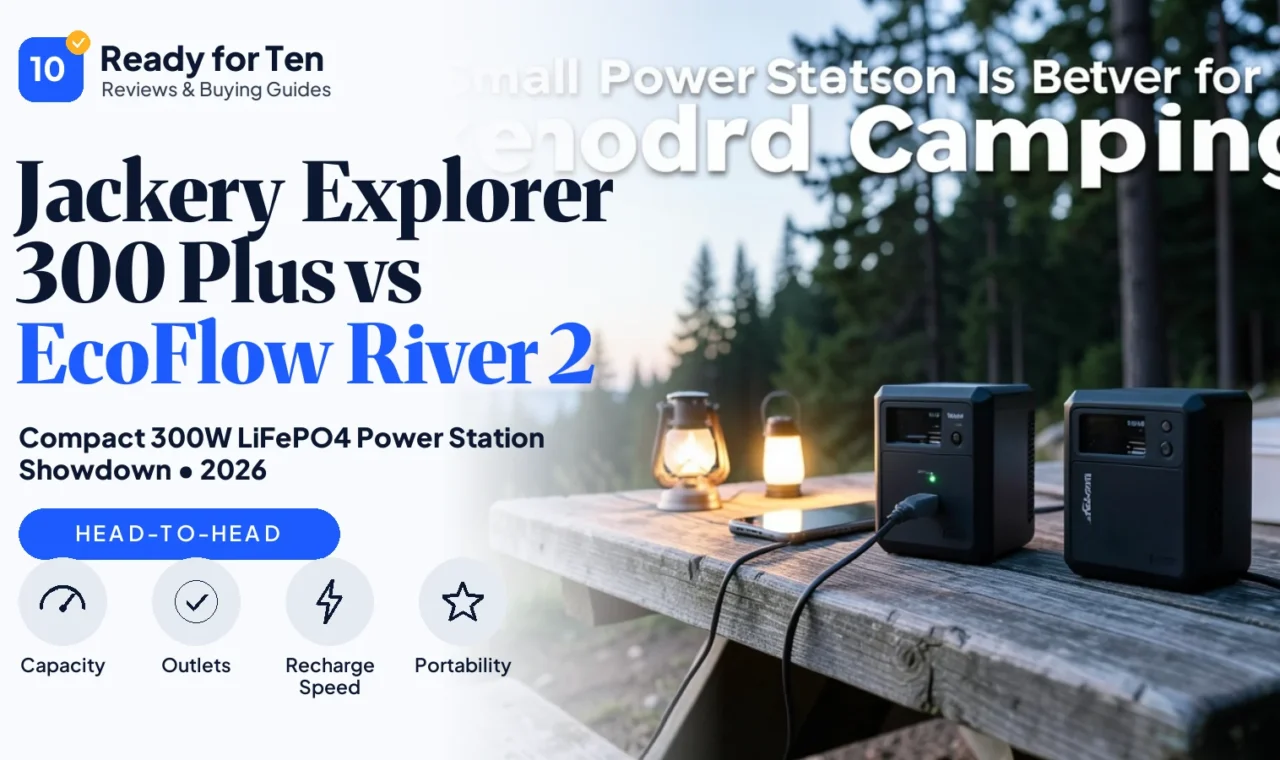
If you are weighing the Jackery Explorer 300 Plus vs EcoFlow River 2, you are probably shopping for the same job: a small, quiet, lithium iron phosphate (LiFePO4) battery box that charges phones, runs lights and a CPAP (ideally without the heated humidifier), and keeps a small 12V cooler going at a car-camping site. I
t should also sit ready in a hall closet for the next storm. Both are rated at about 300W of AC output, and both are small enough to carry with one hand. The differences are in the details.
The short answer: for most weekend campers and outage-prep buyers, I would pick the EcoFlow River 2. It has more AC outlets, recharges from a wall outlet much faster, and its X-Boost mode can run some resistive loads that go slightly past 300W.
The Jackery Explorer 300 Plus is the better pick if you want slightly more stored energy (about 288Wh vs about 256Wh), a simple, familiar interface, and a design that is easy to hand to a less technical family member. Only one of them is the clear choice for you once you decide how much you value charging speed and outlet count against a little extra capacity.
One note on how I wrote this: it is based on manufacturer specifications, the Amazon listings and owner feedback, not on my own bench tests. I do not quote runtime measurements I have not made. Where a spec varies by model year or bundle, I tell you to confirm it on the live listing before you buy. Both brands revise listings, so check the current page.


| Criterion | Jackery Explorer 300 Plus | EcoFlow River 2 |
|---|---|---|
| Rated capacity | About 288Wh | About 256Wh |
| Battery chemistry | LiFePO4 | LiFePO4 |
| AC output | About 300W continuous with surge headroom | About 300W continuous with surge headroom; X-Boost for some higher-wattage resistive loads |
| AC outlets | Fewer (one on most listings) | More (three) |
| USB and 12V ports | USB-C power delivery, USB-A and a 12V car port | USB-C power delivery (up to 100W), several USB-A ports and a 12V car port |
| Wall (AC) recharge | Slower; plan on a few hours for a full charge | Much faster with X-Stream; EcoFlow advertises roughly one hour for a full charge |
| Solar input | Supported; lower input ceiling, so confirm the panel connector and voltage range | Supported; higher input ceiling than the Jackery, so confirm the panel connector and voltage range |
| Weight | Roughly 8 lb class | Roughly 8 lb class (slightly lighter) |
| Control and monitoring | Simpler interface; app support is more basic | Full app with remote control, charge-speed settings and monitoring |
| Warranty | Standard coverage, with extended coverage that may require registration (verify the current terms) | Longer standard coverage than the Jackery on most listings (verify the current terms) |
| Best for | Buyers who want a bit more capacity and a plain, simple unit | Buyers who want fast recharging, more outlets and app control |
Capacity, outlet count, charge speed and warranty are the four rows that most affect a buying decision. Chemistry and output are effectively a draw, since both are LiFePO4 and both are rated at roughly 300W.
Real runtime is always lower than the rated watt-hours. Converting battery power to AC loses some energy, and the inverter draws a small amount of power even when little is connected. Think of a 288Wh or 256Wh rating as a ceiling, not a promise. In practice that means plenty of phone charges, hours of LED lighting, one or two laptop charges, and a CPAP for a night or so. It does not mean running a full-size appliance.
Neither unit is for hair dryers, space heaters, coffee makers, microwaves or electric kettles. Those loads draw more power than a 300W station is meant to deliver, and even where X-Boost can technically start a resistive load, a few minutes would drain the battery. If your camp or outage plan includes any of those, you need a larger unit, and my roundup of bigger power stations is a better starting point than either of these two.
The rest of this comparison goes criterion by criterion: capacity and runtime, ports and power limits, recharging, battery life, weight, warranty and app, price and value, and finally three real scenarios (a Friday-to-Sunday car camp, a short outage and a CPAP night). Each section ends with a clear winner so you can skip to whatever matters most to you.
Check Jackery Explorer 300 Plus price on Amazon
Check EcoFlow River 2 price on Amazon
Capacity and real-world runtime
The Explorer 300 Plus is rated at about 288Wh and the River 2 at about 256Wh. Confirm both figures on the current Amazon listings and the manufacturers’ spec pages before you buy. That is roughly a 12% edge to Jackery. No power station delivers its full rated capacity to a plug, because inverter and conversion losses take a cut. As a rule of thumb, plan on about 80-85% of the number on the box for AC loads.
- Phones: A modern phone battery is around 12-18Wh, so expect somewhere in the low-to-mid teens of full charges from either unit. Jackery should get one or two more.
- LED lights: A string or lantern drawing 5-10W will run for a full weekend of evenings on either one.
- Laptop: A typical laptop charger pulls 45-65W while charging, so expect a few full charges from each.
- CPAP without a heated humidifier: Many machines average 20-40W, depending on pressure and model. Check your machine’s label. One night is realistic on either unit, and Jackery has more margin. Running a 12V DC cable, if your CPAP supports it, wastes less energy than going through the inverter. Heated humidifiers and heated hoses can multiply the draw, and that is where a 250-300Wh unit runs out fast.
- 12V compressor cooler: These draw roughly 40-60W while the compressor runs but cycle on and off. Whether a small one lasts a full day or only part of it depends on the cooler, the ambient heat and how often you open the lid. Pre-chill the contents and don’t expect a whole weekend off one battery. If a cooler is part of your car camping setup, see our best portable power stations for car camping for larger units.
I haven’t bench-tested these two, so these are estimates from the rated capacity and typical device draw, not measured runtimes.
Winner: Jackery Explorer 300 Plus, by a modest margin.
Output ports and power limits
Both are rated at about 300W continuous AC with surge headroom, so neither is a big-appliance machine. The difference is in the layout.
The River 2 has three AC outlets, which helps if you want a light, a fan and a charger brick plugged in at once without a power strip. The Explorer 300 Plus has a single AC outlet, so a strip is the practical fix. Both offer USB-C power delivery at up to about 100W, enough for most laptops. Both also have USB-A ports and a 12V car-style port. Check each spec sheet for the exact USB-A speeds, since they differ between the two.
EcoFlow’s X-Boost mode lets the River 2 run some resistive loads that are rated above 300W by limiting output voltage. It is useful for a small heating appliance on paper, but it is not a license to run a kettle. It also works only with devices that tolerate reduced voltage, and anything with electronics or a motor may not behave properly.
Neither unit should be used for hair dryers, space heaters, coffee makers, microwaves or electric kettles. These typically draw 1,000W or more and would drain the battery in minutes even if they ran at all. If those are on your list, you need a much larger unit, and our roundup of the top 7 best portable power stations for car camping is the place to start.
Winner: EcoFlow River 2, for the extra AC outlets and the X-Boost flexibility.
Recharge methods and speed
This is the River 2’s biggest advantage. EcoFlow’s X-Stream charging is rated at roughly an hour for a full wall charge, depending on the current spec page. The Explorer 300 Plus charges more slowly from a wall outlet. Jackery’s figure is in the range of a couple of hours to 80%, and I would verify it on the listing. For a quick top-up before you leave the house, or between outages, EcoFlow’s speed is a practical benefit.
Both units accept solar and 12V car charging, and both support pass-through, meaning you can run devices while the unit is charging. Pass-through is handy but not a substitute for solar sizing. Solar input on units this size is limited to roughly the 100W class, so check each model’s maximum input wattage and voltage window before pairing a panel. Connector types also differ between brands, so confirm that your panel’s connector matches or buy the adapter cable. Don’t assume a “universal” panel plugs straight in. Car charging through a 12V socket is slow on both, so treat it as a maintenance top-up, not a primary recharge.
Winner: EcoFlow River 2.
Battery chemistry and lifespan
Both use LiFePO4 (lithium iron phosphate) cells, which is a real plus in this class. Compared with the older NMC lithium-ion chemistry, LiFePO4 generally offers a much longer cycle life, better thermal stability and less degradation when kept at a high state of charge. That matters for a unit sitting in a closet waiting for the next outage.
Manufacturers publish cycle ratings that differ in their endpoint (for example, cycles until the battery holds 70% versus 80% of capacity), so the numbers aren’t directly comparable. Jackery rates the 300 Plus at around 4,000 cycles, while EcoFlow rates the River 2 at around 3,000. Check both against current spec pages. Either figure is far more than a weekend camper will ever use. All lithium batteries self-discharge slowly in storage, so top both up every few months. Neither one is a “set it and forget it for years” appliance.
Winner: Tie on chemistry, with a slight paper edge to Jackery on the stated cycle rating.
Weight and portability
These are two of the lightest options in the class. The Explorer 300 Plus weighs roughly 8 pounds and the River 2 a bit under that, around 7.7 pounds. Verify on the listings, but in practice they feel nearly identical. Both have a carry handle, and either fits easily in a trunk, a tent vestibule or the footwell of a back seat. Jackery’s design is a bit boxier and more compact for stacking, and the River 2 is a more rounded shape with a handle that folds flat. If you also want something in the trunk for a dead car battery, see our best portable car jump starters.
For a hall closet kept ready for outages, either works. Both fit on a shelf, and neither has a fan that runs noticeably at idle. Keep either one out of a hot garage or a freezing shed, since lithium batteries are happier at moderate room temperatures.
Winner: Tie, with the River 2 slightly lighter on paper.
Warranty, support and app features
EcoFlow lists a 5-year warranty on the River 2. Jackery offers a standard 3-year warranty on the Explorer 300 Plus, with an extension available by registering the product. Verify the exact terms and registration window on Jackery’s site before assuming you have extra coverage.
The EcoFlow app gives you remote control and monitoring over Bluetooth or Wi-Fi, such as switching AC output on and off, adjusting charging speed and checking input and output wattage. Jackery also has an app for its newer Plus models, but its main selling point is a simple, readable display on the unit itself. Both brands are established, with US-based support and a track record of accessories. Neither is easy to open and repair at home, so plan on warranty service if something fails.
Winner: EcoFlow River 2, for the longer stated warranty and the more capable app.
Price and value
I won’t quote prices, because both move constantly on Amazon. In general, both brands run frequent promotions, and the two often land within a modest price gap of each other. Check the live listing for each before deciding. Cost per watt-hour is the simple measure: divide the price by capacity (288Wh versus 256Wh). If the prices are equal, Jackery gives you more storage per dollar. If EcoFlow is discounted, you are getting faster charging, more outlets and a longer warranty for the same money, which is hard to beat.
Winner: EcoFlow River 2 for features per dollar, Jackery Explorer 300 Plus for raw watt-hours per dollar. It comes down to the day’s price.
Jackery Explorer 300 Plus vs EcoFlow River 2 in real weekend scenarios
Friday-to-Sunday car camp
You’re running lights, charging phones and maybe powering a small compressor cooler. Capacity matters more than outlet count, but the River 2’s three AC outlets and fast recharging make it easier to top up on the drive home. If you have a 12V cooler and a panel, the Jackery’s extra capacity gets you through a bit more. Winner: Jackery Explorer 300 Plus by a nose for the extra watt-hours, River 2 if you plan to recharge on the road. If you are planning the cooking side of the trip too, see our best camping stoves for car camping.
Short power outage
For a few hours without power you need to run a router, charge phones and keep a couple of lights on. Fast recharging is valuable if the power comes back and goes out again, and extra outlets are convenient. Winner: EcoFlow River 2.
CPAP night
Capacity margin is what counts. A CPAP without heated humidifier is feasible on either, but the Explorer 300 Plus has more headroom. Winner: Jackery Explorer 300 Plus.
If your list includes anything over about 300W or you need more than one night of CPAP or fridge power, step up to a larger unit from our car camping power station roundup.
Which should you buy?
Buy the Jackery Explorer 300 Plus if capacity is your priority, especially for CPAP nights or a 12V cooler. It gives you the most watt-hours in the pair and a strong cycle rating, and its simple single-outlet layout is easy to live with. Skip it if you need fast wall charging or several AC outlets.
Buy the EcoFlow River 2 if you want faster recharging, three AC outlets, X-Boost flexibility, a longer warranty and a more capable app. It suits outage prep and weekend campers who recharge between trips. Skip it if you need every last watt-hour for an overnight CPAP margin.
Frequently Asked Questions
Can the Jackery Explorer 300 Plus or EcoFlow River 2 run a CPAP machine overnight?
Often, but not always, and it depends on your machine. Many CPAPs draw roughly 30 to 60 watts with the heated humidifier off, and they draw more with it on. An 8-hour night at 40 watts is about 320Wh. Both units sit in the 250 to 300Wh class, and conversion losses cut into the rated capacity. That makes a full night tight on the River 2 and still marginal on the Explorer 300 Plus unless your machine runs lean. Turn the heated humidifier and heated tube off, and use the DC cable from your CPAP maker if one is available, since it avoids AC conversion losses. Check your machine’s rated wattage on its label or in its manual. If you depend on a CPAP, do a home trial night before you take either unit camping. If your therapy is truly critical, talk to your equipment provider about a purpose-built backup battery.
Can either power station run a small cooler or mini fridge for a weekend?
Not reliably on its own. A 12V compressor cooler cycles on and off, so its average draw is much lower than its running draw. Even so, a Friday-to-Sunday trip is a lot to ask of roughly 250 to 290Wh, especially in summer heat. Either unit can help for a night or a day, or as a backup alongside ice. Thermoelectric (Peltier) coolers run continuously and will drain these batteries quickly, so avoid them. A full-size mini fridge on AC adds startup surge and inverter losses. For a weekend of cold food, pre-chill everything, pack ice, and use the power station as a supplement. If a cooler is the main reason you’re shopping, our Top 7 Best Portable Power Stations for Car Camping covers larger capacities.
Can I use either power station while it is charging (pass-through)?
Both are designed to power devices while they recharge from the wall or solar, which is useful at a campsite with a panel or during an outage. Charging and discharging at the same time generates more heat and adds some wear, so I wouldn’t run it that way as an always-on setup. Because the unit is also supplying a load, it will take longer to fill. Confirm the exact pass-through behavior in each manufacturer’s manual, since firmware and app settings can change it.
How many phones can each one charge, and can it run a laptop?
A typical modern phone battery holds roughly 12 to 15Wh. After conversion losses, the Explorer 300 Plus should manage somewhere in the neighborhood of 15 or more full phone charges. The River 2, with slightly less capacity, should land a bit lower. These are estimates from rated capacity, not test results, and real numbers vary with the phone and cable. Laptops are easy for both. Most have batteries around 50 to 70Wh, so expect a few full charges, and a USB-C PD laptop charges more efficiently over USB-C than through its AC brick. Check each unit’s USB-C wattage against your laptop’s charger rating. If your laptop needs more than the port delivers, use the AC outlet instead, and expect slower charging if it’s under heavy load.
Which one charges faster from a wall outlet, and how do they compare on solar?
The River 2 is the faster wall charger. EcoFlow’s X-Stream charging is built around a roughly one-hour full recharge, while the Explorer 300 Plus is generally slower on standard wall charging and may offer a quicker mode through its app or settings. Check the current manufacturer pages for each figure. On solar, both are limited to a modest panel input in the roughly 100W range, with voltage windows that rule out larger or higher-voltage panels. Match panel voltage and current to each unit’s input range, and check connectors, because you may need an adapter cable. Realistically, a single portable panel will extend your runtime over a weekend but won’t fully offset heavy use.
Are these power stations allowed on airplanes?
No. The FAA limits lithium batteries in carry-on bags to 100Wh without special approval, and allows 101 to 160Wh only with airline approval. Both units are well above 160Wh, so neither can go in a carry-on or in checked luggage. If you’re flying to a camping destination, plan to buy or rent a power station at the other end, or ship it by ground using the carrier’s rules for lithium batteries. Check with your airline and carrier before you travel.
Is a 300W power station enough for a power outage at home?
It’s enough for the basics, with limits. Both units can keep phones charged, run LED lamps, power a Wi-Fi router and modem for several hours, and run a laptop. A CPAP may work for a night, as covered above. Neither should be counted on for a refrigerator or freezer, a well pump, space heaters, kettles, coffee makers, hair dryers, microwaves or window air conditioners. Those either exceed the 300W rating or drain the battery within an hour or two. Think of these as comfort-and-communication backups for a short outage. If you need to keep a fridge cold or run medical equipment for a long outage, step up to a larger power station.
Are the Jackery Explorer 300 Plus and EcoFlow River 2 safe to store for months?
Generally yes. Both use LiFePO4 cells, which are known for good thermal stability and low self-discharge compared with older lithium chemistries. For long-term storage, I’d still follow the usual practice: store at a partial-to-high charge level, keep the unit somewhere cool and dry (a hall closet is fine, a hot garage or car trunk is not), and top it off every few months. Check each manual for its recommended interval, since standby drain and storage guidance differ by brand. Make sure it is powered off and not plugged into anything that could drain it. Run it briefly every so often so you know it still works before you need it.
Final thoughts
Both of these are sensible, compact LiFePO4 power stations for people who want phones charged, lights on and a laptop or CPAP running at a campsite or during a short outage. The differences come down to what you value. The EcoFlow River 2 charges faster from the wall and has more AC outlets, which suits anyone who needs a quick top-up between trips or a power station that’s ready again fast after an outage. The Jackery Explorer 300 Plus offers a bit more capacity and a simpler experience, and it appeals to buyers who want the most runtime in this size class and don’t mind slower wall charging. Neither is a substitute for a larger system if you need to run a fridge, a heater or anything near or above 300W.
Before you buy, check the live Amazon listing for current price, included accessories and warranty terms, because these change with sales and with the bundle you pick. If you find that 300W and 300Wh won’t be enough, our Top 7 Best Portable Power Stations for Car Camping goes up the size ladder.